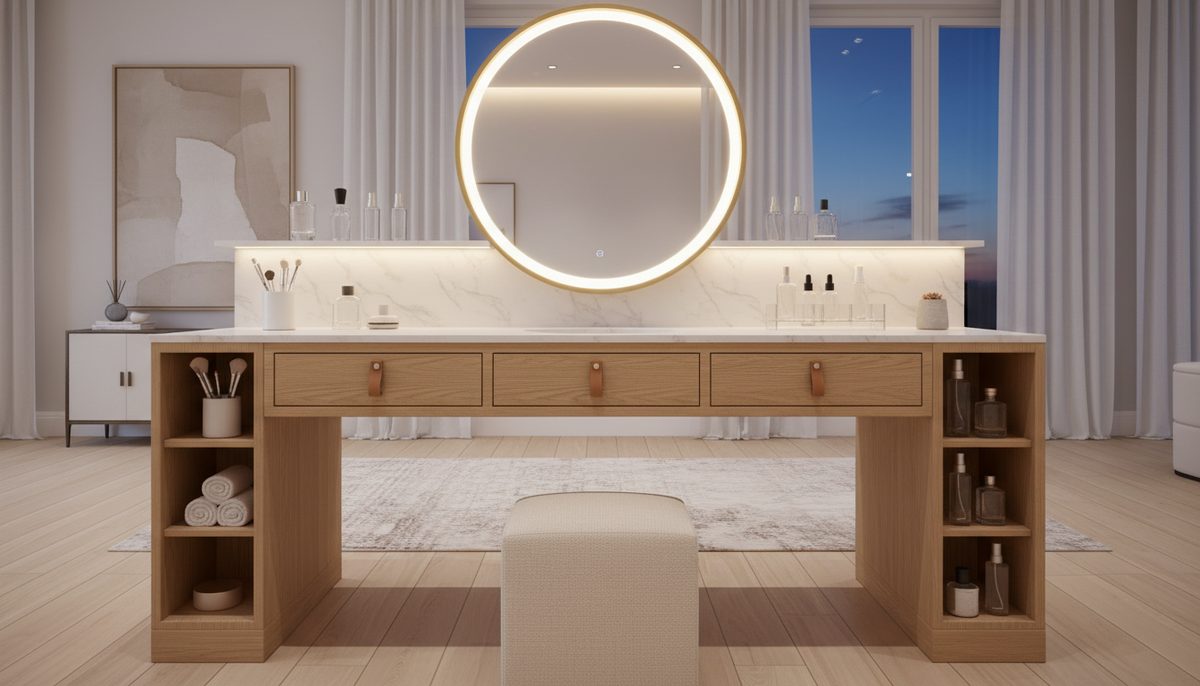
A makeup station is a work surface with a lighting problem attached. Get the seated ergonomics and the light right and a plain table performs better than an ornate piece with a mirror bolted to it. Get them wrong and you will keep drifting to the bathroom counter with a hand mirror.
The dimensions that make it usable
Work from the seated body outward.
- Top height: 28 to 30 inches. This is table height, not the 36-inch counter height of a bathroom vanity or a kitchen counter. At 36 inches your shoulders rise and your elbows have nowhere to rest.
- Knee clearance: at least 24 inches high and 24 inches wide under the top, clear of drawers and stretchers. Center drawers are the enemy of knee space; side pedestals with an open center work better.
- Depth: 16 to 20 inches. Under 16 and you cannot set down a tray and lean in. Over 22 and the mirror sits too far away, which is a real problem for close work like liner.
- Width: 36 inches minimum for a single user, 42 to 48 if you want brush storage on the surface. A 30-inch top works only if everything else lives in drawers.
- Seat height: 18 to 20 inches, giving 9 to 11 inches between seat and top. A dining chair at 18 inches is usually right; a bar stool never is.
Sit down with a tape measure before buying anything. Measure from your seat to your elbow with your upper arm hanging straight; the top should land within an inch of that.
Lighting: the part that decides everything
Overhead light casts shadows down your face, into the eye sockets and under the jaw, which is exactly where you are trying to see. Makeup applied under downlight gets over-applied under the eyes and under-blended along the jawline. Light has to come from the front, at roughly face height, from both sides.
Four specifications matter and only one of them is brightness:
- Position. Two vertical fixtures or bulb strips flanking the mirror, centered between 60 and 66 inches above the floor, spaced 36 to 40 inches apart. Side-mounted beats top-mounted every time. If you can only mount above, use a wide fixture the full width of the mirror and add a small front-facing light on the surface.
- Color temperature: 3500K to 4000K. Warm 2700K bulbs make yellow and orange tones invisible, so foundation looks matched at the vanity and orange in daylight. Cold 5000K+ reads clinical and exaggerates redness. Something near neutral daylight is the honest middle.
- Color rendering index: 90 or higher. This is the single most ignored number. A CRI of 80 flattens reds and browns, which is most of a makeup palette. A CRI 95 bulb at half the lumens will show you more than a CRI 80 bulb at full output.
- Diffusion. Frosted or opal-glass bulbs, never clear filament bulbs at eye level. A bare point source creates hard-edged shadows and glare that makes you squint, and you cannot judge blending while squinting.
Add a dimmer if the station also lives in a bedroom. Being able to drop the output at 11 p.m. is what keeps the setup from being annoying to live with.
Mirrors, magnification and distance
A mirror at least 24 inches tall and 20 inches wide lets you see your head and shoulders, which is how you judge whether the neck and the face match. A small round mirror shows you a face with no context.
Set the mirror so your eye level lands roughly two thirds of the way up the glass when seated. Tilting a wall mirror down 5 to 10 degrees helps if the table depth pushes you back.
On magnification: 5x is the practical ceiling for brows, liner and lashes. 10x and 15x mirrors force your face so close that you work on a region rather than a face, and the result rarely reads well from three feet away. Keep the magnifying mirror as a separate hinged or handheld piece and do all blending in the flat mirror.
Storage sized to what you actually own
Makeup is small, flat and easily lost in deep drawers. Drawer depth requirements are far shallower than furniture makers assume:
- 2 to 3 inches: eyeshadow palettes lying flat, single shadows, compacts, lip products laid down. This is the most valuable drawer in the piece and most vanities do not have one.
- 4 to 5 inches: foundation bottles, primers, setting sprays standing up, brush cups.
- 6 inches or more: hair tools, curling irons, dryers. Add a heat-resistant liner and a grommet if you want to charge or run a cord inside.
Divide every drawer. Acrylic or bamboo dividers that break a drawer into 2 to 4-inch cells turn an unusable pile into something you can shop from. Angled palette organizers waste less vertical space than they look like they will.
Leave the top mostly clear. A tray about 12 by 18 inches for daily items and nothing else keeps the surface functional; every product left standing on the top is a product collecting dust and blocking light.
Bedroom or bathroom
A bedroom location gives you space, a chair that is actually comfortable, and control over the lighting. It also puts powder and setting spray residue on a bedroom floor, so a washable rug or a hard surface underneath is worth planning.
A bathroom location gives you water and existing outlets, and it means the mirror steams. If the station shares a room with a shower, the exhaust fan needs to be sized to the room and run 20 minutes past the shower, or every product and every wood surface lives in a humidity cycle. Wood tops in a bathroom need a sealed film finish, not an oil finish, and any veneered particleboard piece will swell at the edges within a couple of years.
Either way, plan the electrical. A duplex outlet within 18 inches of the surface, ideally at surface height rather than baseboard height, keeps hair tool cords from crossing the seat. In a bathroom that outlet must be GFCI protected. Running an extension cord from across the room is the detail that makes an otherwise good setup unusable.
Repurposing a desk instead of buying a vanity
A writing desk is frequently a better makeup station than a purpose-built vanity, and usually cheaper for the build quality. What you are looking for: 29 to 30-inch top height, open knee space, at least one shallow drawer, and a depth around 20 inches. Add a wall-mounted or freestanding mirror and two sconces and you have skipped the flimsy attached-mirror hardware that fails first on inexpensive vanity sets.
Two upgrades pay for themselves. A washable, wipeable top surface, since foundation stains raw wood permanently and alcohol-based sprays dissolve some finishes. And a chair with a supportive back rather than a decorative stool, because anyone who sits there for twenty minutes will feel the difference by the end of the week.