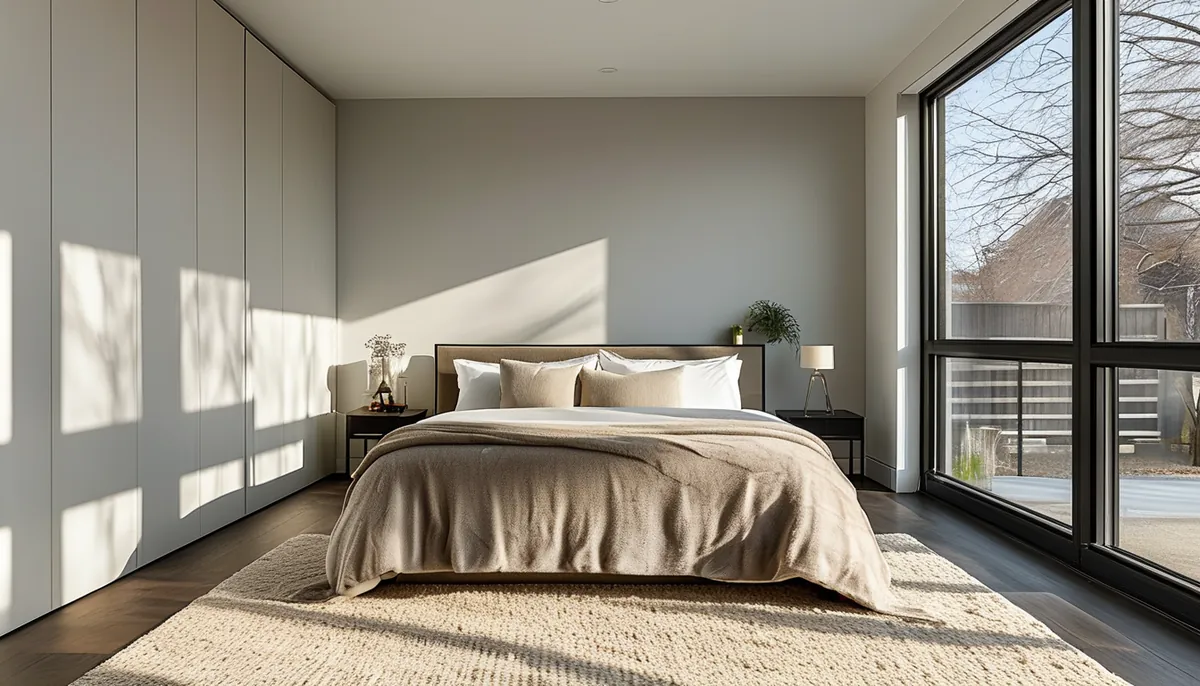
Draw the room to scale before you buy anything. A bedroom has one enormous object in it, and every other decision is downstream of where that object sits and how much space is left around it. Graph paper at 1/4 inch to the foot, cut-out rectangles for the bed, dresser and nightstands, twenty minutes. It will save you a return shipment.
Here are the footprints you are working with. A queen mattress is 60 by 80 inches, a king is 76 by 80, a California king is 72 by 84, and a full is 54 by 75. A bed frame adds roughly 2 to 5 inches on each side and a headboard adds 2 to 6 inches at the top, so a queen bed in a frame occupies about a 66 by 88 inch rectangle, not 60 by 80.
Clearances that decide whether a room feels calm
The difference between a bedroom that feels serene and one that feels crowded is almost always a walkway dimension.
- 30 inches minimum on each side of the bed you sleep on, and along the foot if you walk past it. 36 inches is comfortable. Below 24 inches you turn sideways every time, and the room registers as tight no matter what is on the walls.
- 36 inches in front of a dresser so the drawers open fully and you can stand there. Measure the drawer extension, not the cabinet depth.
- Full swing clearance for the closet and bedroom doors. A bed corner inside a door swing is the single most common planning mistake in small bedrooms.
- Two feet of usable wall for each nightstand. If the bed has to shift so far toward one wall that only one nightstand fits, use a wall-mounted shelf and a sconce on the tight side rather than squeezing in a table that blocks the walkway.
If the numbers do not work, the answer is usually a smaller bed, not cleverer furniture. A queen in a room that breathes beats a king you sidle past.
Get the vertical dimensions right
Height relationships are what make a bedroom look professionally put together, and they are easy to check.
The nightstand surface should land within about 2 inches of the top of the mattress, above or below. Most mattresses today sit 24 to 27 inches off the floor once you account for a platform or box spring, so a 24 to 28 inch nightstand is right. The stubby 20-inch tables that photograph well next to a low platform bed look wrong next to a standard bed with a thick mattress.
Headboard height should relate to the ceiling. In a room with an 8-foot ceiling, a headboard topping out at 48 to 54 inches feels proportional. At 9 or 10 feet, go to 60 inches or more, or add something above the bed to fill the vertical gap. A short headboard on a tall wall leaves a band of dead space that reads as unfinished, and no amount of art at the wrong height fixes it.
Art above the bed hangs with its bottom edge 6 to 10 inches above the headboard, and the piece or arrangement should be about two-thirds the width of the bed. A 24-inch print over a king bed is the classic mistake.
Ceiling fixtures need 7 feet of clearance underneath in a walkway. Pendants flanking the bed hang so the bottom of the shade is at roughly 26 to 30 inches above the floor, which is nightstand-lamp height, and they need to clear your head when you sit up.
Rugs, and the size almost everyone gets wrong
A bedroom rug has one job: to be under your feet when you get out of bed. That means it has to extend at least 18 to 24 inches beyond the sides and foot of the bed, and 24 to 30 inches is better.
Practical sizing: an 8 by 10 rug works under a queen with the top edge starting just below the nightstands, so the rug covers the sides and foot. A king needs a 9 by 12 to do the same job. A 5 by 8 rug under a queen ends up almost entirely hidden under the bed with a strip showing at the foot, which is worse than no rug at all.
The cheaper alternative that actually works: two runners, one on each side of the bed, parallel to it. It costs a fraction of a room-size rug, it puts wool where your feet land, and it looks deliberate in a room with a floor worth showing.
Do not put the front legs of the nightstands on the rug and the bed legs off it, or the other way around. Either all the bed and nightstand legs sit on the rug, or the rug starts below the nightstands and only the bed’s lower two-thirds sits on it. Half-measures look like the rug slipped.
Light it in three layers, and dim all of them
The reason hotel rooms feel better than most bedrooms is not the furniture, it is that nobody ever turns on a single bright ceiling light in one.
Ambient. A flush mount or a fixture with a diffuser, on a dimmer. This is the light you use to find something on the floor, not the light you live by.
Task. Reading light at each side of the bed. A table lamp with the bottom of the shade at roughly eye level when you are sitting up, around 24 to 28 inches above the mattress, puts light on the page and not in your partner’s eyes. Swing-arm sconces mounted 40 to 48 inches above the floor do the same job and free the nightstand surface entirely.
Accent. A floor lamp in a corner, a picture light, or a low-output strip behind a headboard. This is the layer that makes the room look inhabited in a photograph and it is the one people skip.
Color temperature matters more here than anywhere else in the house. Stay at 2700K, warm white, for every bulb in a bedroom. A 4000K bulb suppresses the wind-down your body is trying to do, and it makes warm wood and linen look gray. Put the overhead and the sconces on dimmers, and use bulbs rated for dimming, or you will get flicker and buzz at low output.
Layering textiles without buying a decorator’s worth of them
A bed looks made in three layers, not seven. A fitted sheet and flat sheet, a quilt or coverlet, and a duvet or comforter folded across the lower third. That is the whole formula. The stack of eight pillows in showroom photographs exists to sell pillows.
Pillow arrangement that works on a queen: two sleeping pillows standing against the headboard, two euro squares or shams in front of them, and one lumbar or accent pillow. On a king, three across in the back row. Beyond that you are moving pillows to a chair every night.
Texture does more than color in a bedroom. A room in five shades of oatmeal reads rich if the materials differ: a nubby linen duvet, a smooth cotton percale sheet, a chunky knit throw, a flat-woven wool rug, a velvet or boucle bench at the foot. The same room in five identical materials reads flat.
Upholstery weight matters on the pieces you touch daily. A bench or chair in the bedroom should be in something with a double rub count in the low tens of thousands or above, not a decorative fabric that pills where you sit to put on shoes.
Color, walls and the fifth surface
Bedrooms take color better than any other room because you are usually in them at low light. Deep, saturated walls, forest green, ink blue, a warm clay, make a bedroom feel enclosed and quiet in a way that off-white does not. The trade-off is that dark walls absorb light, so add a lamp you would not otherwise need.
If you want pattern, put it where you do not look while lying down. The headboard wall is the standard choice precisely because you face away from it in bed. A grasscloth or textured covering there adds depth with no visual noise. Molding, board and batten or a slat panel does the same thing in three dimensions and gives the headboard something to sit against.
The ceiling is a real surface and painting it something other than white is one of the cheapest changes with the biggest effect in a bedroom, because it is the only room where you spend hours looking at it. A soft tint two or three steps lighter than the walls, or the wall color itself carried across, closes the room in pleasantly.
Storage that keeps the room from becoming a warehouse
A bedroom that stays calm is one where the closet holds the clothes. If yours does not, the room accumulates a chair covered in laundry and a dresser top covered in objects, and no styling survives that.
Under-bed storage in flat containers uses 6 to 12 inches of otherwise dead volume, and a platform bed with drawers replaces a dresser outright in a room that cannot spare the wall. Vertical shelving beside the closet door, a tall narrow chest at 30 to 36 inches wide instead of a low wide dresser, and a bench with a lid at the foot of the bed all buy capacity without stealing floor.
Give the nightstand a drawer. An open shelf collects a phone charger, a glass, three books, a lip balm and a pair of glasses, and it looks like exactly that.
Small bedrooms specifically
In a room under about 110 square feet, the moves change. Mount lighting on the wall to free both nightstand surfaces. Use a bed with visible legs rather than a solid platform, because seeing floor underneath makes the room read larger. Hang curtains close to the ceiling and wide of the window frame so the wall reads as full-height. Skip the bench at the foot of the bed entirely.
And pick one thing to be the room’s idea: a papered headboard wall, a striking light, a color. A small bedroom with four competing focal points feels chaotic; the same room with one and a lot of quiet around it feels intentional.