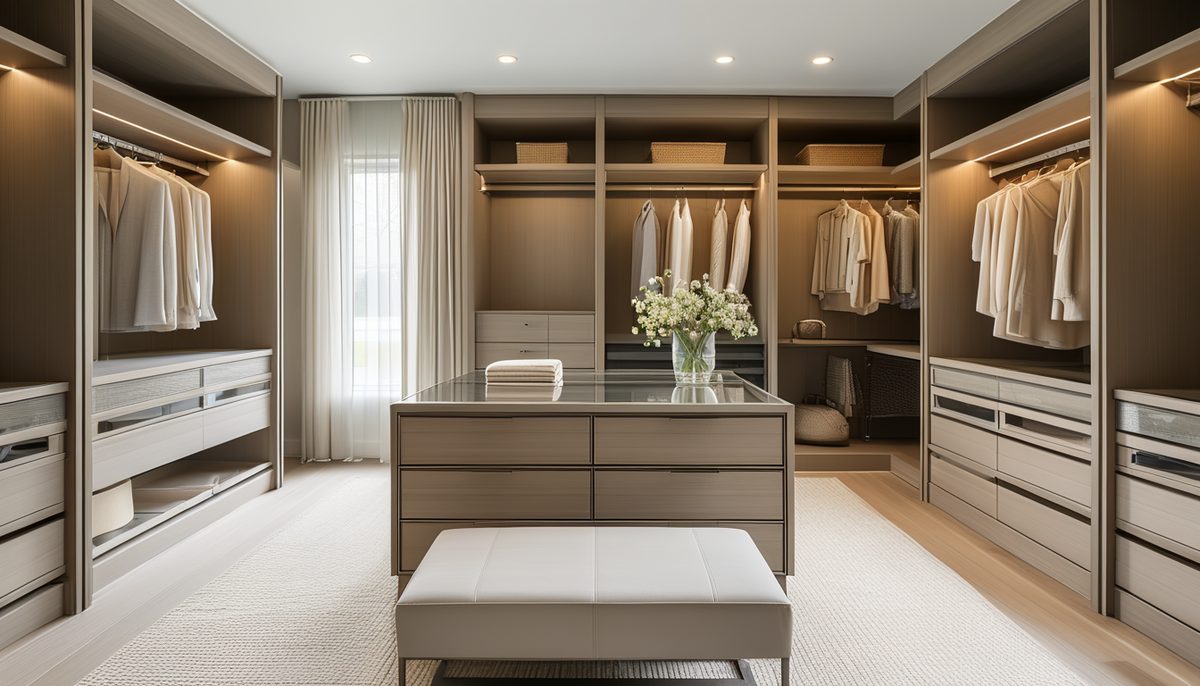
Moving a dresser inside the closet reclaims a wall in a bedroom that probably has three usable walls to begin with. A standard six-drawer dresser occupies roughly 60 by 18 inches of floor, plus the 30 inches of pull space in front of it, which is close to 20 square feet of the room dedicated to a piece of furniture. Getting that back changes how a 10 by 12 bedroom functions. Whether it is possible comes down to four measurements, and taking them wrong is why so many of these projects end with a dresser back out in the room.
The four measurements to take before you buy anything
1. Interior depth, wall to door plane. A standard American reach-in closet is framed at 24 inches deep, which after drywall leaves about 22 to 23 inches of usable interior. A dresser 18 to 20 inches deep fits with room to spare. A 22-inch dresser does not, because you also need clearance for the door to close and for the drawer fronts, which usually project past the case sides.
2. Clear door opening, not interior width. This is the measurement that kills most plans. A closet may be 72 inches wide inside and still have a clear opening of only 34 inches if it has bypass sliding doors, because one panel always covers half the opening. Bifold doors typically give you 80 to 90 percent of the opening once folded back, minus the track hardware. Hinged doors give you the full opening but eat bedroom floor when open. Measure the narrowest point the dresser has to pass through, including the door track at the top and the threshold at the bottom, and compare it to the dresser’s smallest dimension, which will be its depth if you tilt it.
3. Height available under the rod. A single hanging rod is normally set around 66 to 68 inches off the floor, which leaves plenty of room under short-hang clothes but not under long items. A dresser under 36 inches tall sits comfortably below a rod at that height with the clothes hanging clear. If you are keeping full-length hanging space for coats or dresses, that section needs 66 to 70 inches of clear height and cannot have a dresser under it.
4. Pull clearance in front of the drawers. A drawer needs to open its full depth plus room for a person to stand and reach in. For a 20-inch dresser that is roughly 20 inches of drawer travel plus 12 to 18 inches of body space. In a reach-in closet you are standing in the bedroom, so this space usually exists. In a walk-in, check that the open drawer does not hit the opposite wall or a shelf standard on the other side.
Reach-in versus walk-in: two different problems
In a reach-in closet, the dresser is loaded and unloaded from the bedroom side and the closet is effectively a recessed alcove. This is the easier case. The dresser slides in against the back wall, the hanging rod runs above it, and the door closes on the whole assembly. The constraint is entirely the door type. If the closet has bypass doors and the dresser is wider than the clear opening, the practical answer is to remove the doors and treat the closet as an open alcove, or replace them with a curtain on a ceiling-mounted track.
Removing closet doors is worth considering on its own merits in a small bedroom. Bifold doors need 12 to 14 inches of swing clearance and they collect dust in the track. A curtain hung from the ceiling makes the wall read taller, costs almost nothing, and never binds.
In a walk-in closet, the dresser competes with the walkway. The usable aisle in a walk-in should stay at least 24 inches wide to move through and closer to 36 inches if you want to open a drawer and stand there. A walk-in that is 60 inches wide with hanging on both sides has a 24-inch aisle after two 18-inch hanging depths, and a dresser on the end wall works. A dresser along one long side of that same closet leaves you with almost nothing to stand in.
The layout that usually wins
For a typical 6-foot reach-in with a single rod, the arrangement that gets the most out of the space is a double-hang section over the dresser and a long-hang section beside it.
On the dresser side, set the dresser against the back wall and put one rod above it at roughly 40 to 44 inches clear above the dresser top, high enough for folded shirts on the dresser surface and long enough below for shirts and jackets, which need about 40 inches of hanging height. On the other side, keep a full-height rod at 66 to 70 inches for dresses and coats.
Above everything, a shelf at 84 inches or higher takes bins and off-season items. Standard closet shelves are 12 to 16 inches deep, and going deeper just creates a place where things get lost.
If the closet is deep enough and you want the surface, leave 6 to 10 inches of clear wall above the dresser top before the rod so it functions as a landing area for a valet tray, a watch, and keys. That surface is one of the underrated benefits of this arrangement, because it is inside a closet and therefore invisible when the door closes.
Choosing the right dresser for the job
A closet dresser is a different purchase from a bedroom dresser, because nobody looks at it.
- Prioritize depth over face. Skip the decorative case and buy the deepest drawers that fit. Drawer interior depth of 14 to 16 inches holds sweaters folded flat; anything under 5 inches deep vertically is only good for socks and underwear.
- Tall and narrow beats wide and low in most reach-ins, because vertical space under a rod is what you have and horizontal space is what the hanging needs. A 30-inch-wide, 48-inch-tall chest fits under a high double-hang rod and leaves more of the closet width for clothes.
- Check the drawer glides. Full-extension ball-bearing glides let you reach the back of the drawer in a dark closet. Wooden runners or partial-extension glides mean the back third of every drawer is unusable in practice.
- Watch the handles. Knobs and pulls that project 1.5 to 2 inches can be the thing that stops the door from closing. Recessed or flush pulls solve it, and so does removing the handles entirely on a drawer with a finger notch.
- Toe kicks and legs. A dresser on 4-inch legs loses drawer volume but makes vacuuming possible. A dresser sitting flat on the floor maximizes storage but will trap dust and, on an exterior wall, can trap moisture.
Built-in drawer banks made from cabinet boxes are the upgrade path. A stack of three or four drawer units sized to the closet interior wastes nothing at the sides, which a freestanding dresser always does. The trade-off is that it is permanent and the sizes are fixed.
Lighting, air, and the practical annoyances
A closet with a dresser in it becomes a place you actually work, which means it needs light. A single bulb behind a closed door does not reach into a drawer. Battery or rechargeable LED strips with a motion sensor mounted under the shelf and above the rod solve it without an electrician. If you are running power, a fixture must maintain the clearance from stored materials that the electrical code requires, and enclosed LED fixtures are far easier to place than an exposed bulb.
Air matters more than people expect. A closed closet on an exterior wall in a humid climate is the most likely place in a bedroom to grow mildew, and filling it with a dresser blocks what little air movement there was. Leave a 1 to 2 inch gap between the dresser back and the wall, keep the door open when the room is unoccupied, and skip storing anything damp. Cedar and moisture absorbers help at the margins; airflow does the actual work.
Two smaller irritations worth planning for. First, the closet floor is often unfinished or carpeted with a different material than the bedroom, and a heavy dresser dragged across it will mark. Slide it on furniture glides or a piece of cardboard. Second, a dresser tipping hazard does not go away because the dresser is in a closet. Anchor it to a stud with an anti-tip strap, especially if children live in the house.
When it is the wrong idea
A dresser inside a closet costs you hanging space, and that is a real trade. If the household hangs most of its clothes, converting half the rod into drawer storage means the other half now carries everything, and you end up with a jammed closet and a half-empty dresser.
It is also wrong in a closet under 22 inches deep, which older houses have plenty of. A 16-inch-deep closet takes shelving and hanging on a shallow rod, not a dresser.
And it is wrong if the bedroom already has a wall doing nothing. The point of the exercise is reclaiming floor area in a tight room. In a bedroom with space to spare, a dresser out in the room is easier to use, easier to light, and gives you a surface for a lamp.