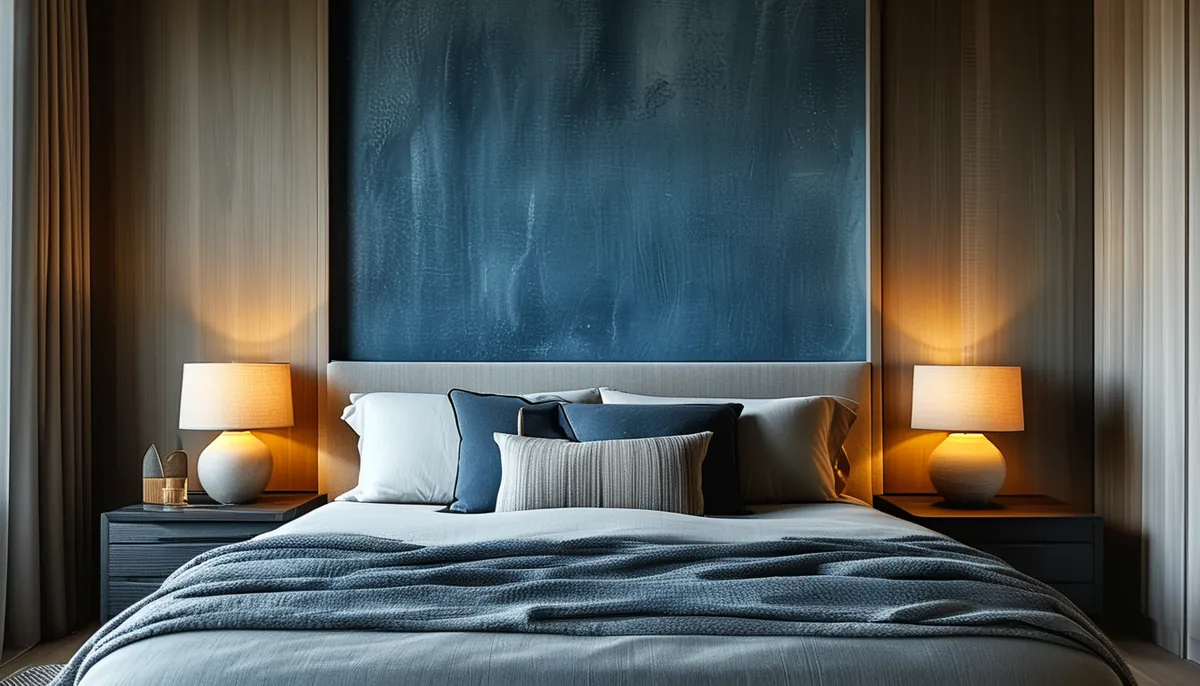
In a bedroom under about 130 square feet, an accent wall is not decoration you add on top of the room. It is the thing that tells your eye where the room ends, and picking the wrong surface makes a tight room feel tighter. Start by choosing the wall, and choose it by function rather than by which one looks emptiest.
The headboard wall, almost always
The wall behind the bed is the accent wall in a small bedroom for three reasons. It is the wall you never look at while you are in the room, so a strong treatment does not become tiring. It is the wall the bed already anchors, so the treatment reinforces a focal point instead of creating a competing one. And it is usually the least interrupted surface in the room.
The alternatives fail for specific reasons. The window wall backlights any color you put on it, so the wall reads as a dark silhouette during the day regardless of what you chose. The closet wall is broken up by doors and door casing, and a treatment that stops and restarts around bifold doors reads as patchwork. The entry wall is the one you see from the hallway, which means the accent announces itself before you even walk in and the room feels smaller from the doorway.
One exception is worth taking. If the bed has to sit under a window because the room only allows one layout, accent the wall opposite the door instead and keep the bed wall quiet.
A second exception: in a room with a sloped or knee-wall ceiling, treat the sloped plane as the accent surface. It is already the defining shape of the room and paneling or paper on it turns an awkward attic bedroom into a deliberate one.
Dark colors in small rooms actually work
The advice to paint small rooms light comes from a real observation and draws the wrong conclusion. Light walls in a small bedroom show you exactly where every corner is, which is what makes the room feel like a box. A deep color on one wall does the opposite: the corners fall into shadow, the wall edge stops being readable, and the room loses its measurable limit.
Practical guidance if you go dark. Choose a color with a light reflectance value under about 25 for the accent and keep the remaining three walls in the same hue family at a much higher value, so the room reads as one color at two intensities rather than two unrelated colors. Deep blue-greens, charcoals with a warm undertone, and near-black browns hold up best under warm bulb light. Saturated true reds and bright navies go muddy in a small room at night.
Finish matters as much as color. Use matte or a washable eggshell on the accent wall. Any sheen above eggshell on a dark color turns the wall into a mirror for the bedside lamp and every roller mark shows.
If you go light instead, the accent has to come from texture rather than color, because a pale accent wall next to pale walls simply reads as a paint mismatch.
Scaling pattern to a 10-by-11 room
Small rooms do not require small patterns. That is the most persistent bad advice in bedroom decorating. A tiny repeat on a 10-foot wall reads as noise from 6 feet away and makes the wall look busy.
What actually works is a large repeat with low contrast. A 24- to 36-inch repeat means you see two or three motifs on the whole wall, which reads as composition rather than as pattern. Keep the value difference between the motif and its background modest and the wall stays calm at that scale.
The one geometry rule worth keeping: vertical emphasis in a room with an 8-foot ceiling, horizontal emphasis in a room with a 9- or 10-foot ceiling and a small footprint. A vertical stripe or a floor-to-ceiling batten run in a low room adds apparent height, and in a tall narrow room it makes the space feel like a shaft.
Measure before ordering. A 10-foot wall at 8 feet high is 80 square feet, which is two or three double rolls depending on repeat waste. Buy from the same run number and buy one extra roll, because a reorder six months later rarely matches.
Texture instead of color
In a rental, or in a room where you want the accent to survive changing bedding, texture beats color.
Vertical batten strips. The cheapest visual upgrade available. Battens 2.5 inches wide at roughly 16 inches on center, painted the same color as the wall, add shadow lines without adding a second color. In a small bedroom, running them the full height to the ceiling rather than stopping at a rail is what buys the apparent height.
Slat panels. Wood or WPC slats on a backer, installed in sections. They add real depth and they absorb some sound, which matters in a small hard-surfaced room. They also cost more and eat about three-quarters of an inch of floor depth, which is a real consideration when the nightstand clearance is already tight.
Grasscloth and textured wallcovering. Reads as one warm surface rather than a pattern. Grasscloth shows seams by design and is not the right choice next to a bed where hands touch the wall, but on the wall behind a headboard it is excellent.
Peel-and-stick wall panels. The renter option. Realistic on the flat surfaces, less convincing at the edges, so plan how the treatment terminates at the corners before you buy.
Working around the obstacles a small bedroom has
Nightstand clearance is the constraint people discover after installation. Any applied treatment adds 1/4 to 1 inch of thickness. If the bed plus two nightstands already spans within an inch of the wall width, that added thickness means one nightstand no longer fits. Measure the wall, add the treatment thickness on each end if it wraps the corners, and check.
Outlets behind the bed need to stay usable. If you are adding panels or battens, plan a full bay clear of the outlet, and fit a box extender so the receptacle sits flush with the new surface.
Wall-mounted reading lights change the calculation. Sconces on a paneled wall need blocking behind the drywall or a mounting point on a batten, and both have to be located before the treatment goes up. Retrofitting a sconce into a finished slat wall is not a small job.
Ceiling line. In a small bedroom, carrying the accent color across the ceiling makes the room feel like a defined volume instead of a short box. It is the single most effective thing you can do in a room with an 8-foot ceiling and it costs one extra gallon.
What to leave alone
Do not accent two walls. In a room this size, two treated walls means half the surfaces are competing and the room reads as chaotic rather than layered.
Do not add a strong accent wall and keep a busy comforter and busy curtains. Something has to be quiet, and in a small room it should be everything except the wall.
Do not run the accent behind a wall-mounted TV. A dark textured surface behind a black screen creates a dead zone the eye keeps returning to.