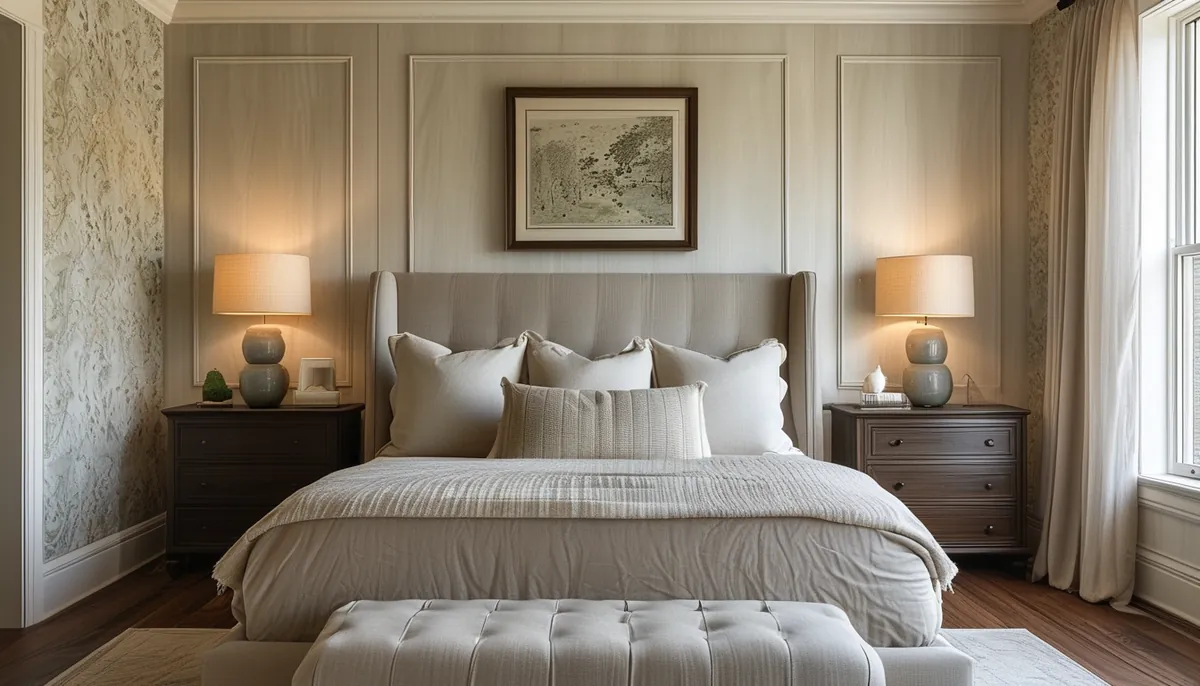
The number that predicts how a primary bedroom will feel once the paper is up is the vertical repeat, printed on the label and ignored by almost everyone. A 4-inch repeat reads as texture. A 25-inch repeat reads as a composition, gives you two and a half motifs on an 8-foot wall, and produces roughly twice the waste. Both can be right. Choosing without checking is what produces a bedroom that feels busy at 6 a.m.
Which walls to paper in a primary bedroom
Three approaches, and the room usually decides.
The headboard wall only. The default and the safest. The bed already claims that wall, the treatment reinforces it, and you never lie in bed looking at it. In a room where the bed floats on a long wall with nightstands, this is the whole answer.
All four walls. This is the choice a large primary bedroom can actually support, and it produces a completely different result from an accent wall. Wrapping the room makes it feel enclosed and quiet, which in a bedroom is a feature rather than a problem. It requires a paper with a low-contrast pattern or a texture. A high-contrast botanical on four walls in a bedroom is exhausting within a week.
Above a chair rail or paneling. Paper the upper two-thirds and put paneling or a deep paint color below. This works in rooms with 9- or 10-foot ceilings and it solves the problem of a large-scale pattern that would overwhelm the full height.
The wall to avoid is the one with the window, unless you are wrapping the whole room. Papering only the window wall means the pattern is permanently backlit and half of it is broken up by casing.
Also consider the ceiling. A paper on the ceiling of a primary bedroom, with the walls painted a color pulled from it, is one of the few treatments that works better in a bedroom than anywhere else, because the ceiling is the surface you actually look at from bed.
Pattern scale, honestly
Match the repeat to the wall you are covering, not to the size of the room. A 12-foot headboard wall with an 8-foot ceiling holds a 20- to 30-inch repeat comfortably. On the same wall a 6-inch repeat is going to read as a solid textured field from the doorway, which may be exactly what you want.
Contrast matters more than scale for whether a bedroom stays restful. Two papers with the same 24-inch repeat feel entirely different if one has a cream motif on an oatmeal ground and the other has black on white. In a room where you sleep, keep the value range narrow.
Directional patterns need a decision. Stripes, chinoiserie panels, and anything with an obvious top and bottom have to be planned around the ceiling line. If the ceiling drops an inch across the wall, a horizontal element in the pattern will show it. Non-directional and random-match papers hide that.
Match type appears on the label and controls the waste. A straight match lines up horizontally across every strip, which is the easiest to hang and the most wasteful with a long repeat. A drop match offsets each strip by half the repeat, which reduces waste and demands more attention. A random match, common in grasscloth and stripes, has no alignment at all and produces almost no waste.
Material: what belongs in a bedroom
Non-woven. The best default. You paste the wall rather than the paper, it does not expand when wet so the seams butt cleanly, and it strips off dry in full sheets years later. Available in nearly every pattern now.
Grasscloth and natural fiber. Real texture, warmth, and a light-absorbing surface that photographs beautifully. It also has visible seams and panel-to-panel color variation by nature, not by defect. Sellers say so in the fine print and buyers are still surprised. It is the right choice for a headboard wall in a primary bedroom and the wrong choice for a hallway or a kid’s room, because it stains from a single touch and cannot be wiped.
Peel and stick. The renter’s option and increasingly good. It needs a smooth eggshell or satin wall that has cured three weeks or more, and it will not bond to chalky flat paint. On a textured wall it lifts at the edges. Realistic expectations: it looks excellent for two to four years and comes off without a steamer.
Prepasted paper. The traditional product. Cheapest per roll, more work per strip, and it expands when soaked, so strips have to be booked for the specified time or the seams will gap as they dry.
Solid vinyl. Durable and scrubbable, which a bedroom does not need. It also has less breathability, which matters on an exterior wall in a humid climate.
Color and how the room changes at night
A bedroom is used at two extremes of light: full daylight and one warm bedside bulb. Test both. Tape a full-width sample to the headboard wall and look at it at 8 a.m., at 3 p.m., and at 10 p.m. with only the lamps on.
North-facing bedrooms get cool, even light all day, which pushes gray papers toward blue and makes cool greens look sickly. Warm-toned papers, clay, ochre, and warm neutrals, hold their color there.
South-facing bedrooms get warm, strong light that washes out pale patterns by midday. A pattern that looks subtle on the sample will nearly disappear on a south wall.
Warm LED bulbs at 2700K flatten blues and deepen yellows. If the room is used mostly after dark, weight the decision toward the lamp-lit test rather than the daylight one.
Ordering: the math and the waste
Measure each wall’s width and multiply by the ceiling height to get square footage. Do not subtract for doors or windows unless an opening is larger than about 15 square feet, and even then subtract conservatively.
A single roll in the US market commonly covers around 28 square feet of usable area after trim and matching, though the label figure is higher. With a repeat under 12 inches, expect to lose 10 to 15 percent to matching. With a repeat over 20 inches, budget 25 to 30 percent. A random-match grasscloth loses almost nothing.
Buy every roll from the same run or batch number and check the numbers when the box arrives. Dye lots differ visibly, and a mismatched roll in the middle of a wall cannot be hidden. Order one full roll beyond your calculation and keep it. Patterns are discontinued constantly, and the spare covers a future repair around a relocated sconce.
Living with it after it is up
Plan the outlets and switches before hanging. Kill the breaker, remove cover plates, paper over the box, then cut back to the opening. Cover plates can be papered with offcuts, which makes them disappear on a busy pattern.
Sconces are the one thing to settle first. A wall-mounted reading light retrofitted into finished wallpaper means cutting the paper and patching around a new box, and the patch will show. Locate sconces, run the wiring, install the boxes, and then paper.
Headboard clearance is a real issue with grasscloth and other delicate materials. Pull the bed frame a half inch off the wall or add felt pads to the back of the headboard, because a headboard rubbing against natural fiber wears a shiny line into it within a year.
Cleaning depends on the material. Non-woven and vinyl take a barely damp microfiber cloth. Grasscloth takes a vacuum brush attachment and nothing else. For any paper, work top down so drips do not run over cleaned areas.
The one thing worth spending on is the install of the first strip. Snap a plumb line rather than trusting the corner, start on the wall opposite the door so the inevitable pattern mismatch at the final corner lands where you see it least, and check plumb on every third strip rather than trusting the seam.