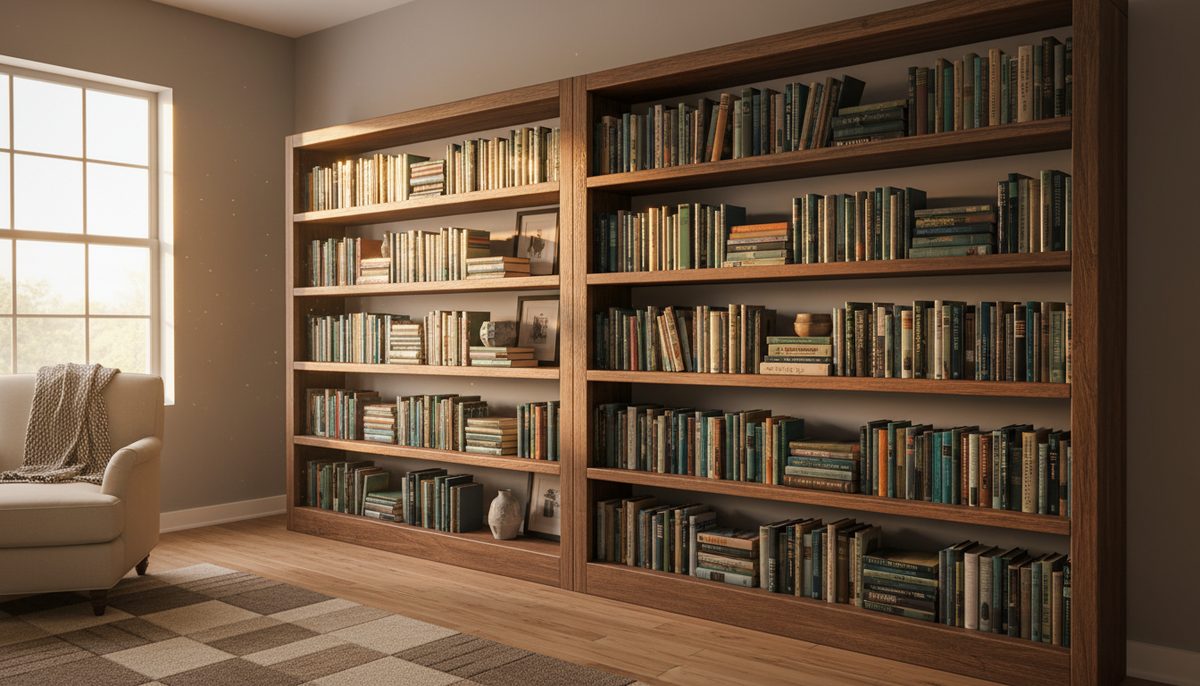
A packed shelf of hardcovers weighs roughly 20 to 25 pounds per running foot. Paperbacks run closer to 12 to 15. Binders, textbooks and art books push past 30. That single figure explains almost every sagging shelf: a 36-inch span carrying hardcovers is holding 70 to 75 pounds in the middle, and most shelf material sold at that width was never engineered for it.
Span is the number that decides everything
Sag is a function of span, thickness and material, and span dominates because deflection rises sharply as the unsupported distance grows. Doubling the span does far more damage than halving the thickness.
Practical limits for a shelf loaded with books, with support at both ends only: particleboard and melamine-faced particleboard at 5/8 or 3/4 inch should not exceed about 24 to 30 inches. MDF at 3/4 inch is similar, slightly better in stiffness but heavier. Plywood at 3/4 inch handles 32 to 36 inches. Solid hardwood at 3/4 inch handles 36 inches, and at 1 inch will go to 42.
Anything wider than that needs help: a center divider, a vertical support, a stiffener glued to the front edge, or a metal shelf standard system. A 1 1/2-inch solid wood face strip glued and screwed to the front edge of a plywood shelf roughly triples its stiffness for the cost of a piece of trim, and it also hides the plywood edge.
When you are looking at a bookshelf in a store, ignore the overall width and look at the distance between vertical supports. A 72-inch-wide unit with a center divider is two 35-inch spans and it will be fine. A 48-inch-wide unit with no divider is a 47-inch span and it will bow within a year, no matter what the box says about capacity.
Check whether shelves are fixed or adjustable, too. Fixed shelves housed into a dado in the side panel are stronger and they stiffen the whole case. Adjustable shelves on 5 mm pins rest on four small points, and cheap plastic pins deform under load. If a unit is adjustable, look for metal pins and a supported edge.
Material, in the order you should prefer it
Solid hardwood is the strongest and the heaviest, and it costs the most. It tolerates being disassembled and moved, and it can be refinished.
Plywood with a hardwood veneer is the best value for real book storage. It is dimensionally stable, screws hold well in the face, and 3/4-inch cabinet-grade plywood is close to solid wood in stiffness.
MDF takes paint better than anything else and has no grain to telegraph, which is why painted built-ins are usually MDF. It is heavy, it does not hold screws well in the edge, and it swells irreversibly if it gets wet. Do not put MDF shelving in a basement with humidity problems or in a bathroom.
Melamine-faced particleboard is the cheapest and it is fine for light loads: a linen closet, kids’ toys, a display shelf. It fails under books, and the failure is permanent because the sag sets even after you unload it.
Metal and glass units look light and open, but check the glass thickness. Tempered glass under 3/8 inch on a span over 30 inches is a display shelf, not a book shelf.
On veneer, look at the edge banding. Paper-thin banding that is already lifting on the showroom floor will lift faster at home, and it is the first thing that makes an inexpensive unit look inexpensive.
Depth, height and how it fits the wall
Ten to 12 inches of shelf depth handles almost every book. Mass-market paperbacks are about 4 1/4 by 7 inches, trade paperbacks about 6 by 9, standard hardcovers 6 1/2 by 9 1/2. A 12-inch shelf covers all of those with room for the spine to sit slightly proud, which is easier on the eye and easier to grab.
Sixteen inches is oversized for books and turns into a place where objects get lost behind other objects. It is the right depth only if you are storing binders, records, or baskets. Vinyl records need 13 inches clear plus a little, and they are heavy: about 15 to 20 pounds per running foot, so treat a record shelf like a hardcover shelf.
Vertical clearance between shelves matters more than most people plan for. Nine inches of clear height handles paperbacks. Eleven inches handles standard hardcovers. Fourteen inches handles most art and coffee-table books, and some oversized books need 16. Set the bottom bay tall and the upper bays shorter; heavy oversized books belong low anyway.
Height is a room decision. A 72-inch unit reads as furniture and stays below the sight line in most rooms. A unit that runs to the ceiling reads as architecture and makes an 8-foot ceiling feel taller, but it needs a step stool and it is much harder to move. In a room with crown molding, a tall unit either has to be scribed around the molding or it stops a few inches short, and that gap collects dust.
A row of two or three matching units side by side reads as built-in for a fraction of built-in cost, especially if you add a baseboard-matching plinth and a piece of trim across the top to close the gap to the ceiling.
Anchoring is not optional
Any bookcase taller than it is wide can tip, and a loaded one tips with enough force to injure a child. Anchor it. Every tall unit sold in the US comes with a strap or bracket for a reason.
Find a stud with a stud finder and confirm by driving a small test hole; studs are typically 16 inches on center, sometimes 24 in newer construction. Use a lag screw or heavy wood screw into the stud, not a drywall anchor, and leave the strap slightly slack rather than pulled tight, so seasonal movement does not tear it out.
If no stud lands behind the unit, a heavy-duty toggle bolt in drywall is the fallback. Plastic expansion anchors are not adequate for tip restraint.
Load heavy items on the bottom shelves. A bookcase with all the art books on top is unstable even when anchored, and it is also the fastest way to sag the shelf you look at most.
Check the back panel, too. A thin hardboard back stapled on is what keeps a case square; if it is loose or missing, the unit racks into a parallelogram over time. Adding screws through the back panel into the shelf edges every 8 inches takes ten minutes and stiffens the whole thing.
Matching the type to the room
In a home office, a unit 30 to 36 inches wide beside the desk keeps reference material within reach without blocking light from a window. Closed lower doors hide the printer and the cable mess and stop the room from reading as storage.
In a living room, low units at 30 to 36 inches tall running along a wall give you display surface at eye level when seated, and they do not need anchoring against a wall you would rather keep visually open.
In a bedroom, a narrow tall unit at 18 to 24 inches wide fits the leftover wall between a closet and a corner, which is space no dresser can use.
For a room divider, both sides are visible, so the unit needs a finished back or no back at all, plus a floor-mount or ceiling-mount restraint since there is no wall to strap to.
In a nursery or a kids’ room, forward-facing picture-book displays with a 3-inch lip hold books cover-out at 4 to 6 inches deep, and the shelf load is trivial. Mount them low enough that a child can reach without climbing, and anchor anything tall in the room without exception.
What to check before you pay
Push the assembled floor model at the top corner. If it racks noticeably, the joinery is weak and it will get worse loaded.
Look at the shelf edges from the side, along their length. Floor models are usually loaded with light props, and if one is already showing a bow, that is your answer.
Read the stated load rating per shelf and compare it to your actual load: multiply the shelf width in feet by 25 pounds for hardcovers. A 36-inch shelf rated for 40 pounds is not a bookshelf.
Ask whether the unit ships flat-packed and whether the sides are drilled for adjustable pins. Flat-pack cases with cam-lock hardware lose strength every time you take them apart, so a unit you plan to move twice should have real joinery or metal-to-metal connectors.
Measure the doorway and stair turn before ordering an assembled unit taller than 6 feet. It is a common and expensive surprise.