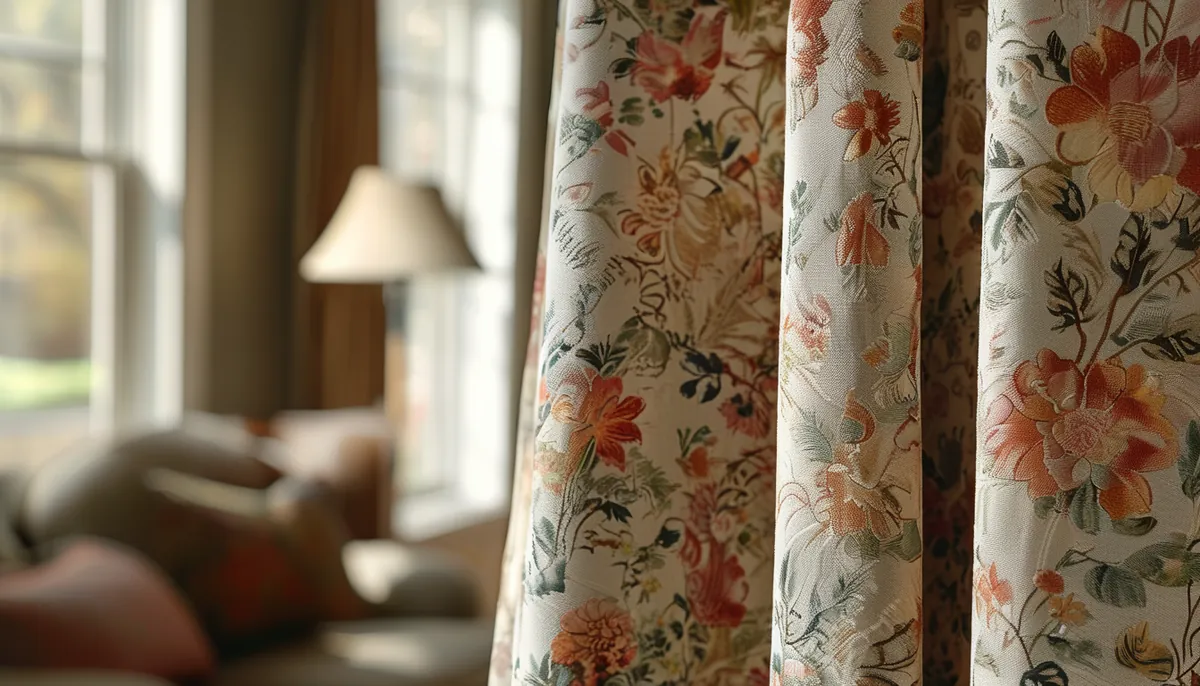
Two very different things get sold under this name, and confusing them wastes money. One is genuine old yardage: deadstock bolts, mill ends, salvaged curtains and slipcovers from the 1930s through the 1970s. The other is current production printed with period designs, often from a mill’s own archive. The first has real age and real risk. The second has none of either, and it is the right answer for anything you sit on daily.
Decide which one you need before you shop, because the buying process for each is completely different.
Testing genuine old yardage before you pay
Cotton, linen and rayon degrade with light, humidity and time. A bolt stored in a dry closet can be perfect at seventy years; the same fabric folded in a sunny window for a decade is fiber dust held together by pattern. Five checks, all of which take under a minute.
The tug test. Take a section between both hands and pull firmly on the bias, the diagonal. Sound fabric stretches slightly and springs back. Fabric with dry rot gives with a soft tearing sensation and does not recover. Do this on an edge or a fold, not in the middle of the piece.
Check the folds. A bolt folded for forty years develops weakness along every crease. Open the fabric fully and look through it at a light. If the fold lines show as bright lines where the yarns have thinned, you cannot use those areas, and on a bolt folded every 18 inches that eliminates a lot of usable yardage.
Look for the light line. Fabric that was a curtain has a fade gradient. Hold the full width up and compare one selvage to the other. A piece that is three shades lighter along one edge is only usable if you can cut around the faded band, which effectively narrows the goods.
Smell it. Mustiness from storage usually airs out. A sharp sour or mildewed smell means the fiber has been wet, and wet cellulose fiber loses strength permanently. Cigarette smoke in old fabric is very hard to remove and will come back in a warm room.
Inspect the back. Turn the fabric over. Brittle latex or acrylic backing that flakes off in your hand is common on 1960s and 1970s upholstery goods, and it means the fabric will not survive being stretched over a frame.
Reading durability: rub counts and where they land
Modern upholstery fabric carries a double-rub count from an abrasion test. The rough tiers: under 9,000 is decorative only, 9,000 to 15,000 is light residential use, 15,000 to 30,000 covers general residential, and 30,000 and up is heavy duty and contract-grade.
Genuine vintage yardage almost never has a documented number, and even when the original tag survives, the test methods have changed and the fabric has aged. Assume old goods perform a tier or two below whatever they were rated when new.
That is not a reason to avoid them. It is a reason to place them correctly:
- Throw pillows. Almost no abrasion. The best possible use for a small piece of something wonderful, and the reason a single yard is worth buying.
- Chair backs, wings and outside arms. Very little wear. A common professional move is to use the vintage fabric on the back and outside of a chair and a durable modern coordinate on the seat deck and inside arms, where the wear happens.
- Occasional chairs, dining chair seats, benches, headboards. Reasonable for sound vintage fabric. A dining chair seat gets sat on but not slid across.
- A sofa the family uses nightly. Not a place for old fabric. Use a reproduction print instead.
Cleaning codes, and why old fabric often has none
Contemporary upholstery fabric carries a code that tells you what the maker tested it against. W means clean with water-based products. S means solvent only, and water will ring or shrink it. WS means either works. X means vacuum only, no liquid of any kind.
Old yardage usually arrives uncoded, so test before you commit. Cut a 2-inch square from a scrap, wet half of it with distilled water and blot dry. Look for color bleeding, a hard water ring, or shrinkage at the edges. Repeat with a dry-cleaning solvent on another scrap. Whatever the scrap tolerates is your cleaning method for the life of the piece, and you should write it down and tape it under the frame.
Rayon, common in mid-century barkcloth and jacquards, is the most water-sensitive of the group. It loses substantial strength when wet and it shrinks, sometimes dramatically. If a piece tests as rayon-heavy, it is a solvent-clean fabric and it should never be steamed.
Do not launder old yardage before upholstering unless you have tested a full-width sample. Vintage fabric can shrink 3 to 8 percent, and if you shrink half a bolt you may no longer have enough to cover the piece.
Yardage math, width and the repeat
Modern upholstery fabric is typically 54 inches wide. Older goods are frequently 36, 45 or 48 inches, and drapery-weight vintage can be narrower still. That difference alone can add 30 to 50 percent to the yardage you need, and it is the number most people forget.
Rough planning figures for 54-inch goods, before adding for pattern:
- Dining chair seat, drop-in: about 3/4 to 1 yard each.
- Fully upholstered dining chair with a back: 2 to 3 yards.
- Wing chair: 6 to 8 yards.
- Standard club chair: 5 to 7 yards.
- Three-cushion sofa: 14 to 18 yards.
- Queen headboard, flat: 3 to 4 yards.
Then add for the pattern repeat. A large repeat means every cut has to start at the same point in the design so the motifs align across a seat and a back. The standard allowance is to add the length of one vertical repeat for every major cut piece. On a fabric with a 27-inch repeat and a chair needing eight cuts, that is nearly six extra yards. On a small repeat under 4 inches, the allowance is negligible.
Check whether the fabric can be railroaded, meaning turned 90 degrees so the width of the goods runs horizontally along the piece. Railroading a sofa lets you cover the full back with no seam, and it can cut yardage substantially. A non-directional texture railroads freely; a floral with an obvious top and bottom cannot, and a stripe becomes horizontal when railroaded, which is either the point or a disaster.
Buy everything at once and from one bolt. Dye lots differ, and with old goods there is no reorder at all. Add 10 percent over your calculation for cutting errors and for the piece you will want to replace in ten years.
Working with it on the frame
Old fabric benefits from a backing. A lightweight knit fusible interfacing, applied to the reverse with a press cloth and a moderate iron, adds body and keeps a slightly fragile weave from splitting at the staple line. Test the heat on a scrap first, because some vintage synthetics will melt or glaze.
Use a fresh, sharp needle and lengthen the stitch slightly on aged fabric. A dense stitch line perforates weak yarns and creates a tear line at exactly the seam you need to hold.
Tell your upholsterer what they are getting before the fabric arrives. Working with old goods takes longer, staples have to be placed more carefully, and cut mistakes cannot be corrected with another yard. Most will happily do it and most charge more, and both of those are reasonable.
Protecting it once it is on the piece
Sunlight is the main enemy. Direct sun through untreated glass fades and embrittles natural fibers fast, and a chair in a west-facing window will visibly change within a couple of years. Move the piece, or use a UV-filtering window film.
Vacuum with a brush attachment and light suction rather than a beater bar. Rotate loose cushions weekly so the wear and the fading distribute evenly. Blot spills immediately; never rub, which breaks surface fibers and creates a permanent dull spot.
Keep the offcuts. Any scrap larger than a hand is a future patch, and with vintage goods, a patch cut from your own leftovers is the only match you will ever get. Store them flat, in the dark, in a breathable cotton bag rather than a plastic bin.