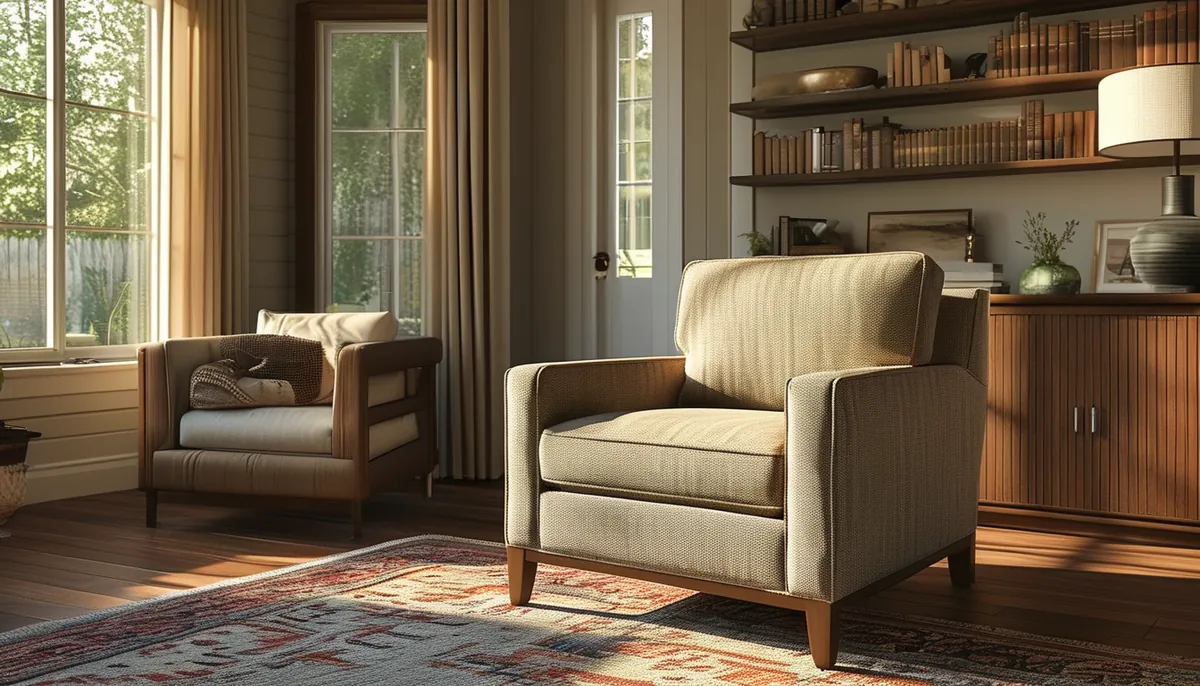
The look comes from weave and hand, not from print. Original 1950s and 1960s seating was covered mostly in tightly woven wool and wool blends, nubby textured cloth, and early synthetics with a dry, flat surface. That is why a smooth cotton twill on a walnut frame looks off even in the right color: it reflects light evenly, and the era’s fabrics did not.
Weaves that actually read mid century
- Wool and wool-blend tweed. The closest match to what came on the original frames. Flecked two-tone or three-tone yarns break up the surface so the fabric reads as one color from across the room and as several up close. Durable, resists pilling, and hides use better than any solid.
- Boucle. Looped yarn with a bumpy surface. It has the right texture and it photographs beautifully, but the loops snag. In a home with a cat, boucle is a mistake you make once. Choose a tight, small-loop version if you want it anyway.
- Low-pile velvet and mohair. Period-correct on lounge chairs and settees. Look for pile height under about 2 millimeters and a woven, not knitted, back. Cotton and mohair velvets crush and mark; polyester performance velvets resist crushing but can read slightly too shiny for the era.
- Flat woven textures and barkcloth. Barkcloth is the crinkled, slightly rough cotton behind most of the atomic and abstract prints of the period. It is the right surface for a print, and it is a poor choice for a heavy-use seat because it abrades faster than wool.
- Vinyl and faux leather. Genuinely period-correct on office and dining chairs. Modern polyurethane faces are softer and less prone to cracking than the vinyl of the era, but check the backing: a knit backing flexes on curved seats, a woven backing is stiffer and better on flat panels.
What does not read mid century: heavy chenille, printed cotton florals with a country feel, and anything with a large sheen difference between warp and weft. Those belong to later decades and they fight walnut.
Durability numbers to check before you order yardage
Two abrasion tests appear on spec sheets in the United States. Wyzenbeek results are given in double rubs; Martindale results are given in cycles. They are separate tests and there is no reliable conversion between them, so compare a fabric only against others measured the same way.
Common thresholds for Wyzenbeek double rubs: under 9,000 is decorative and belongs on a headboard, a pillow, or a chair nobody sits in. Around 15,000 is the usual heavy-duty residential line and is fine for a sofa in a normal household. Contract-grade goods run 30,000 and up, which is more than a home sofa needs but is worth paying for on a dining chair seat that gets dragged and wiped every day.
Two more numbers matter. Pilling resistance is rated 1 to 5, and anything below 4 will fuzz on a seat cushion within a year. Lightfastness, often reported in AATCC hours, tells you whether the color holds; a saturated mustard or teal in a south-facing bay window will shift noticeably if the rating is low. Wool holds color well, and unlined bright polyesters are the usual offenders.
Yardage for common mid century frames
Most upholstery fabric in the United States runs 54 inches wide. Estimates below assume 54-inch plain goods with no pattern match; add 15 to 25 percent for a pattern with a large repeat, and add a full yard if you are unsure.
- Dining chair, seat pad only: half a yard to 1 yard each.
- Dining chair, seat and back: 1.5 to 2 yards each.
- Armless slipper or side chair: 3 to 4 yards.
- Lounge chair with arms and loose cushion: 5 to 7 yards.
- Lounge chair with matching ottoman: add 1.5 to 2 yards.
- Loveseat or settee: 8 to 12 yards.
- Three-seat sofa with tight back: 12 to 16 yards.
- Sofa with three loose back cushions and welt: 16 to 20 yards.
Order all of it in one cut from one dye lot. Dye lots vary enough that a replacement cushion cut six months later will not match, and on a solid mid-tone the difference is obvious in daylight. Buy an extra yard beyond your estimate and keep it flat and out of sunlight; that yard is what saves the piece after a burn or a tear.
Railroaded versus up the roll
Up-the-roll fabric has its pattern running along the length of the roll, so the usable run without a seam is 54 inches. Railroaded fabric has the pattern turned 90 degrees and runs sideways off the roll, which lets an upholsterer cover a sofa back wider than 54 inches in one continuous piece with no vertical seam.
This matters most on long, low mid century sofas, which are frequently 78 to 90 inches wide with a single tight back. A directional stripe that is only available up the roll means either a seam in the middle of the back or a stripe running horizontally instead of vertically. Neither is wrong, but decide it on purpose, and tell the upholsterer which way you want the pattern to run before the fabric is cut.
For patterned goods, find the repeat on the spec sheet: it is given as a vertical repeat and a horizontal repeat in inches. A 27-inch vertical repeat on a chair with three cushions means aligning the motif across all three, which is where the extra yardage goes.
Colors that sit right with walnut and teak
The wood is the fixed element. Walnut is a cool-leaning medium brown; teak is warmer and more golden and ambers further with age. Both are mid-tone, so a mid-tone fabric in the same value disappears against them.
Colors that carry the period without turning into a costume: mustard and ochre, olive and moss, rust and burnt orange, teal and petrol blue, oatmeal, charcoal, and a warm off-white. Avoid pure cool gray, which reads 2015 rather than 1958, and avoid a brown fabric within two shades of the frame.
If you want an atomic or abstract print, put it on one piece only, ideally a lounge chair rather than the sofa. A print on the largest object in the room dates the room and limits everything else you can add. A textured solid on the sofa with a print on a single chair or a pair of pillows gives the same reference and stays livable.
Cleaning codes and households with pets
Every upholstery fabric carries a cleaning code, and it decides how the piece ages more than the fiber content does.
- W clean with water-based products.
- S solvent only; water will ring it. Common on rayon and some wool blends.
- WS either water or solvent. The most forgiving code and the one to look for on a family sofa.
- X vacuum only, no liquid at all. Fine on a decorative pillow, wrong on any seat.
With pets, weight the decision toward tight flat weaves and away from loops. Claws catch loops and pull them into runs that cannot be repaired invisibly. A tightly woven wool blend, a performance velvet with a woven back, or a good faux leather all take claws far better than boucle. Solution-dyed fibers hold up to repeated cleaning because the color is in the fiber rather than on it.
Fix what is underneath before you re-cover
Fabric on a tired frame is money spent twice. Before ordering, flip the piece and check three things. Sinuous springs should snap back with even tension and no gaps at the clips; broken clips are inexpensive and worth replacing while the deck is open. Webbing on a rubber-webbed Scandinavian-style frame stretches and sags with age, and replacement webbing is a straightforward job once the old cover is off.
Foam density is the third. Seat cushions want a density around 1.8 to 2.5 pounds per cubic foot for a cushion that holds its shape for years; anything lighter compresses within a season and no fabric hides a collapsed cushion. Wrap new foam in polyester batting so the cover fills out with a soft edge rather than a hard corner.
Also check the joints. Mid century frames often use doweled joinery rather than corner blocks, and a loose dowel joint creaks under load. Reglue and clamp it before the new cover goes on, because getting back to that joint later means taking the fabric off again.