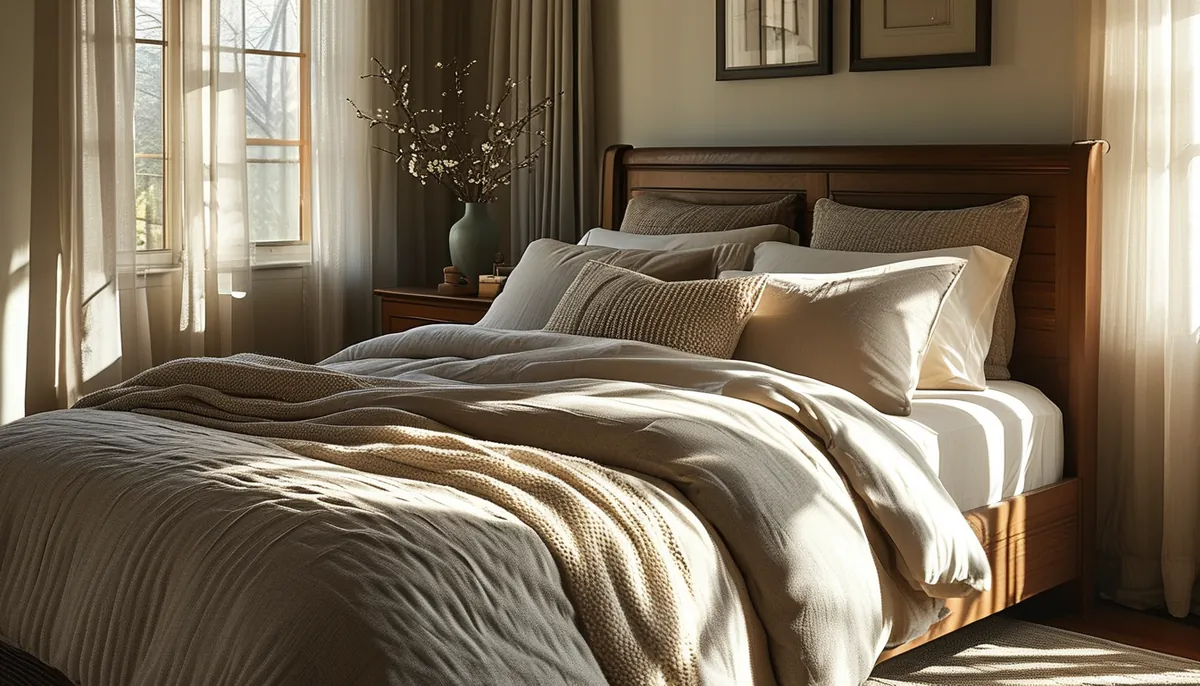
A bedroom is the one room where the largest object is fixed in size and impossible to shrink. A queen mattress is 60 by 80 inches, a king is 76 by 80, a full is 54 by 75. Every decorating decision that follows is negotiating with those numbers, which is why the prettiest scheme collapses the moment someone has to turn sideways to reach the closet.
Set the clearances before you set the mood
Walk the room with a tape measure and mark the bed footprint on the floor with painter’s tape. You want 24 inches of clear walkway on any side someone sleeps on, 30 inches if two people share and one gets up at night. At the foot of the bed, 36 inches is comfortable and 30 is the floor, less than that and a dresser drawer cannot open.
Door swings eat more space than anyone plans for. A standard 30-inch interior door needs a 30-inch quarter circle of clear floor, and a closet door swinging into the room can cost you an entire nightstand. If the tape shows the bed blocking a swing, changing the door to a slider is often cheaper than downsizing the bed.
Rugs follow the bed size. An 8 by 10 under a queen leaves roughly 18 to 24 inches of rug showing on each side and at the foot, which is the amount your feet actually land on. A king wants a 9 by 12 for the same effect. The common mistake is a 5 by 7 floated at the foot of the bed; it reads as a bath mat from the doorway and makes the room look smaller than the bare floor would.
Set the mattress top height and write it down. Most platform and box-spring setups land between 22 and 26 inches. That single number determines nightstand height, sconce height, and whether a bench at the foot looks intentional.
The bed wall does most of the work
Everything a bedroom design is judged on happens on one wall. Spend there and go quiet everywhere else.
Treat the headboard and nightstands as one unit
Buying a headboard and two nightstands separately is how you end up with a 58-inch headboard and 30-inch nightstands that read as three unrelated objects. Composed as a unit, the nightstand surface should sit within 2 to 4 inches of the mattress top, so with a 24-inch mattress height you want tables 22 to 28 inches tall. Anything shorter means reaching down for a glass of water in the dark.
Width matters as much as height. A nightstand narrower than 18 inches holds a lamp or a book, not both. For a queen with 30 inches of wall on each side, tables 20 to 24 inches wide fill the space without crowding the pillows. Match the two sides if the wall is symmetrical, and deliberately mismatch only when one side has a window or a door forcing your hand.
Headboard height scales with ceiling. On a 96-inch ceiling, 48 to 54 inches above the floor is the range that reads substantial without looming. On a 9-foot ceiling you can go to 60 inches or run a wall treatment above the headboard to bridge the extra air.
A platform bed buys back visual space
Platform frames sit lower and eliminate the box spring, which drops the mattress top to 18 to 22 inches. In a room under 11 by 12 feet, that lower horizon makes the ceiling read taller and leaves more visible wall. Platforms with visible legs beat solid plinth bases in small rooms, because seeing floor continue under the bed is what tells your eye the room keeps going.
The tradeoff is storage and getting up. Under-bed clearance on a leggy platform is often 6 to 8 inches, enough for flat bins and nothing else, and a low mattress is harder on anyone with bad knees. Measure from your knee crease to the floor while seated: if the mattress top lands well below that, you will feel it every morning.
Get pattern scale right before you get pattern taste right
Large-scale pattern on one wall
A motif under 8 inches across reads as texture from six feet away, which is why small florals disappear in photos and in person. On a bed wall you are looking at from 10 to 14 feet, motifs need to be 15 inches or larger to hold their shape. A single wall of large-scale wallpaper behind the bed does more for a room than the same pattern on all four walls, and it costs a quarter as much.
Before ordering, tape a full repeat of the pattern to the wall at bed height and live with it for two days, morning and night. Pattern that looks calm on a screen can be relentless at 6 a.m.
Geometric motifs need a straight line to sit against
Geometrics are unforgiving of crooked rooms. A trellis or diamond pattern on a wall whose ceiling drops three-quarters of an inch across 12 feet will show that drop clearly, because the eye reads the pattern grid as level and blames the architecture. On an out-of-square wall, choose an organic or non-directional pattern instead, or confine the geometric to a bounded area, inside picture frame molding or below a chair-rail line at 32 to 36 inches.
Mixing geometrics works on a scale rule: one large, one medium, one small, sharing two colors. Three patterns at the same scale fight.
Color block with quilts and bedding, not paint
Bedding is the cheapest large color surface in the room and the easiest to reverse. A solid quilt in a saturated color folded across the bottom third of the bed gives you a horizontal band of color roughly 24 to 30 inches deep, sitting against neutral sheets. That band does the work an accent wall does, without primer.
Keep the blocks large and few. Two colors plus white reads deliberate. Four colors reads like laundry. If the room already has a patterned wall, the quilt should pick one color out of that pattern rather than introduce a fifth.
Teal is the saturated color that behaves
Deep teal works in bedrooms where navy goes cold and forest green goes heavy. It carries enough blue to read restful and enough green to stay warm under the yellow light most bedrooms are lit with, which is why it survives the 2700K bulbs in a bedside lamp.
Test it properly. Paint two 24-inch squares of the actual color, one on the darkest wall and one near the window, and look at both at 8 a.m., 3 p.m. and 10 p.m. with the lamps on. Teal shifts more than almost any other hue between daylight and incandescent light, and the sample that looked like slate at noon can look like turquoise at night.
If a full room of teal feels like a commitment, put it on the bed wall alone and repeat it in one textile, a lumbar pillow or the quilt band, so the color has a partner across the room. Pair it with warm woods, unlacquered brass, and off-white rather than stark white; teal against a cool white reads clinical.
Light the room in three layers
A single ceiling fixture flattens a bedroom and puts your shadow on the closet every time you cross the room. Three sources fix it: an overhead for cleaning and dressing, a reading source at each side of the bed, and something low and warm for the last hour of the day.
A paper pendant instead of a table lamp
Swapping bedside table lamps for a pair of hanging pendants frees the entire nightstand surface, which in a 20-inch-wide table is most of the usable space. Hang the bottom of the shade 20 to 26 inches above the nightstand top, or roughly 46 to 52 inches off the floor, so the glare cone falls below your eyes when you are sitting up in bed.
Large paper or rice-paper globes work in a bedroom because the diffusion is total, the fixture weighs almost nothing on a drywall anchor, and a 24-inch sphere reads as sculpture during the day. Any pendant crossing the walking path needs its bottom edge at least 7 feet off the floor. If there is no ceiling box in the right spot, a swag hook and a cord run to an existing box is a legitimate answer, as long as the cord is pinned and not draped.
Sconces are the alternative when the ceiling is textured or the room is a rental. Center them 30 to 36 inches above the mattress top and 6 to 10 inches outboard of the pillow edge.
Lucite and leggy pieces in a tight room
Two objects the same size can carry completely different visual weight. A 20-inch solid wood nightstand blocks the floor behind it; a lucite or acrylic one of the same footprint lets the flooring and baseboard read straight through. In a bedroom under 120 square feet, that transparency is worth more than the storage you give up.
Use it in one or two places, not throughout. A clear bench at the foot of the bed, a clear desk chair, or a single acrylic side table keeps the trick from turning into a theme. Acrylic scratches, so keep it away from the side of the bed where belt buckles and phone cases land, and clean it with a soft cloth rather than paper towel.
The same principle covers non-transparent furniture. Pieces on visible legs, open-frame shelving, and wall-mounted floating nightstands all show more floor. Floor you can see is the cheapest square footage in the room.
The order to actually do things in
Sequence saves money. Ceiling first, then walls, then any molding or paneling, then flooring, then furniture, then textiles, then art. Painting after the wallpaper goes up means cutting a line against a papered edge, which is slow and rarely clean.
Buy the rug before the bedding. The rug is the hardest element to change your mind about and the one with the fewest options in the size you need, so let it set the palette rather than trying to match it later. Bedding, pillows and a quilt are the last 10 percent of the budget and the part you will swap twice in five years anyway.
One more discipline: leave one wall empty. Every bedroom that photographs well has a wall doing nothing, and it is what makes the wall doing something look intentional.