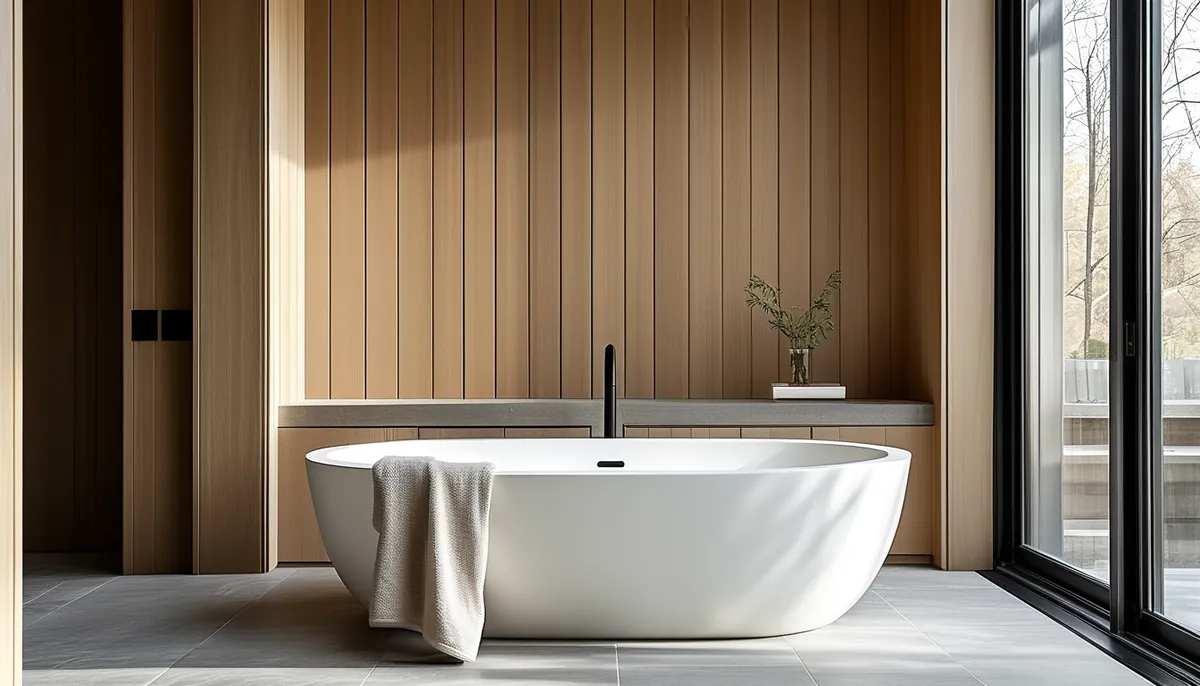
Everything you put in a bathroom lives in a room that swings from 40 percent relative humidity to near saturation twice a day, gets splashed, and is cleaned with chemicals that strip finishes. That is why bathroom decor fails faster than decor anywhere else in the house, and why the useful question is not what looks good but what looks good in eighteen months.
Start with the fan, because it decides everything else
The exhaust fan is the least glamorous item in a bathroom and the one that determines whether the rest of your choices survive. A rough sizing rule for a bathroom under 100 square feet is 1 CFM per square foot, with a floor of 50 CFM, and more if you have a separate enclosed toilet or a steam shower. A 60-square-foot bathroom with a 50 CFM fan that the previous owner installed in 2003 is probably moving less air than that today, since duct runs, elbows, and a lint-clogged grille all cut real airflow.
Run it during the shower and for at least 20 minutes afterward. A cheap timer switch does this without anyone remembering, and it is the single change that most reduces peeling paint, warped vanity doors, and mildew in grout. Every decorating decision below assumes the room actually dries out between uses.
Materials that hold up, and the ones that do not
The failures are predictable enough to list.
- Paper-faced art without glass ripples within weeks. Anything on paper needs glazing and a sealed back, or it needs to hang on the wall furthest from the shower.
- Raw MDF and particleboard swell at the bottom edge where water sits. A floating shelf made of MDF over a sink is a countdown. Solid wood, plywood with sealed edges, PVC, or metal instead.
- Untreated natural fiber, including jute, seagrass, and natural grasscloth, absorbs moisture and can spot or mildew. Vinyl-faced wallcovering with a woven texture gives the same look without the failure mode.
- Iron and unsealed brass spot and pit. Stainless, powder-coated steel, solid brass with a living finish that is expected to patina, or plated finishes rated for bath use all hold better.
- Peel-and-stick wallcovering works in a powder room with no shower. In a full bath, it needs a well-primed, fully cured painted surface and it still tends to lift at the top corner nearest the shower. Non-woven wallcovering hung with a mildew-resistant adhesive over a properly primed wall is the durable version.
For paint, the meaningful spec is not the sheen alone but the resin. A quality acrylic in eggshell or satin formulated for kitchens and baths resists moisture and scrubbing far better than a builder-grade flat, and modern bath-rated paints no longer force you into a high-gloss look to get durability.
The six changes that move the needle most
Decorating a bathroom well is mostly about sequence. These are ordered by visual impact per hour of work.
1. Replace the mirror. A frameless builder mirror glued to the wall is the single largest flat surface in most bathrooms and the most anonymous. Size it to the vanity: the mirror should be narrower than the vanity top, generally by 2 to 4 inches on each side, and centered on the sink rather than on the wall if those are not the same point. Hang the center at roughly 60 to 65 inches off the floor for a mixed-height household.
2. Change the lighting. Overhead-only lighting throws shadows down the face, which is why every hotel bathroom you liked had light at the sides. Two sconces flanking the mirror at about 60 to 66 inches, roughly 36 to 40 inches apart, is the arrangement that flatters. If wiring for sconces is not available, a wide fixture above the mirror with a diffusing shade beats a bare three-bulb bar. Use 2700K to 3000K bulbs with a color rendering index of 90 or above, because low CRI light makes skin look gray and makes every color decision in the room look worse.
3. Swap the hardware. Faucet, cabinet pulls, towel bar, robe hook, and toilet paper holder in one consistent finish read as a renovation even when nothing was renovated. Mixing two metals works if there is a clear rule, usually plumbing fixtures in one finish and cabinet hardware plus lighting in the other. Mixing three reads as accidental.
4. Deal with the textiles. Towels in one color at consistent size, a bath mat that fits the space rather than a small rectangle floating in the middle, and a shower curtain hung high. A curtain rod mounted at 84 inches or just below the ceiling rather than at the standard 72 inches makes the room read taller instantly, and the curtain needs to be long enough to match.
5. Add one wall treatment. A single treated wall does more than any number of accessories. Beadboard or shiplap to 36 to 42 inches with a cap rail, PVC or WPC wall panels behind the toilet, picture frame molding on the wall opposite the vanity, or a patterned wallcovering above a chair rail. In a small bathroom this is where the personality has to live, because there is no floor space for anything else.
6. Hide the clutter. Nothing undermines bathroom decor faster than eleven plastic bottles on the counter. Closed storage for anything used daily, and a tray to corral the two or three items that stay out.
Scale rules for a small room
Most American bathrooms are between 35 and 60 square feet, and the usual decorating error is using too many small objects. Three tiny frames on a wall read as clutter. One large piece reads as intentional. The same applies to plants: one substantial plant that tolerates low light and high humidity, such as a pothos or a snake plant, beats five small succulents that will not survive a room with a single north window.
Wall art hangs at a center height around 57 to 60 inches in most rooms, but in a bathroom you also need to check it against the towel bar and the toilet tank lid. Above a toilet, leave at least 8 to 10 inches between the tank and the bottom of the frame or shelf so the lid can come off.
Shelving over the toilet is the standard small-bath move and it is usually done badly. Floating shelves 6 to 8 inches deep hold folded towels and a basket; anything deeper starts hitting heads. Space them 12 to 14 inches apart vertically. Two shelves look composed, four look like a stockroom.
Color, and why bathrooms tolerate more of it
A bathroom is a room you occupy briefly and leave, which makes it the best place in a house to use a color you would not live with in a living room. Deep green, oxblood, near-black, and saturated patterns all work here specifically because the exposure is short. Powder rooms with no natural light are the strongest case: a dark saturated color turns a windowless box into a deliberate jewel box, while pale paint in the same room just looks dim.
The constraint is the existing tile. If the floor is a strong pattern or a warm travertine tone you are not replacing, choose the wall color against the tile, not against a photo. Hold the sample flat on the floor. Cool gray walls over warm beige tile is the mismatch that makes tens of thousands of American bathrooms look unresolved, and it is fixed by moving the wall color toward the tile’s temperature rather than fighting it.
Where the money is usually wasted
- Matching accessory sets. A soap dish, tumbler, and tissue box cover in the same resin pattern date the room faster than anything else in it.
- Rugs that block the door swing. Measure the swing arc before buying. A rug that has to be kicked aside every entry gets kicked aside permanently.
- Over-the-door hooks on a hollow-core door. They chip the paint and they do not hold a wet towel’s weight for long. Hooks screwed into a stud or a properly anchored wall instead.
- Decorative towels nobody uses. If the room only has space for one towel bar, it belongs to the towel people actually dry with.
- Air fresheners standing in for ventilation. A room that needs constant fragrance has a moisture problem, and covering it delays the repair.
Done in the right order, decor for bathroom spaces is cheap relative to its effect: mirror, light, hardware, textiles, one wall treatment, and storage. Nothing on that list requires a plumber, and together they change the room more than a new vanity would.