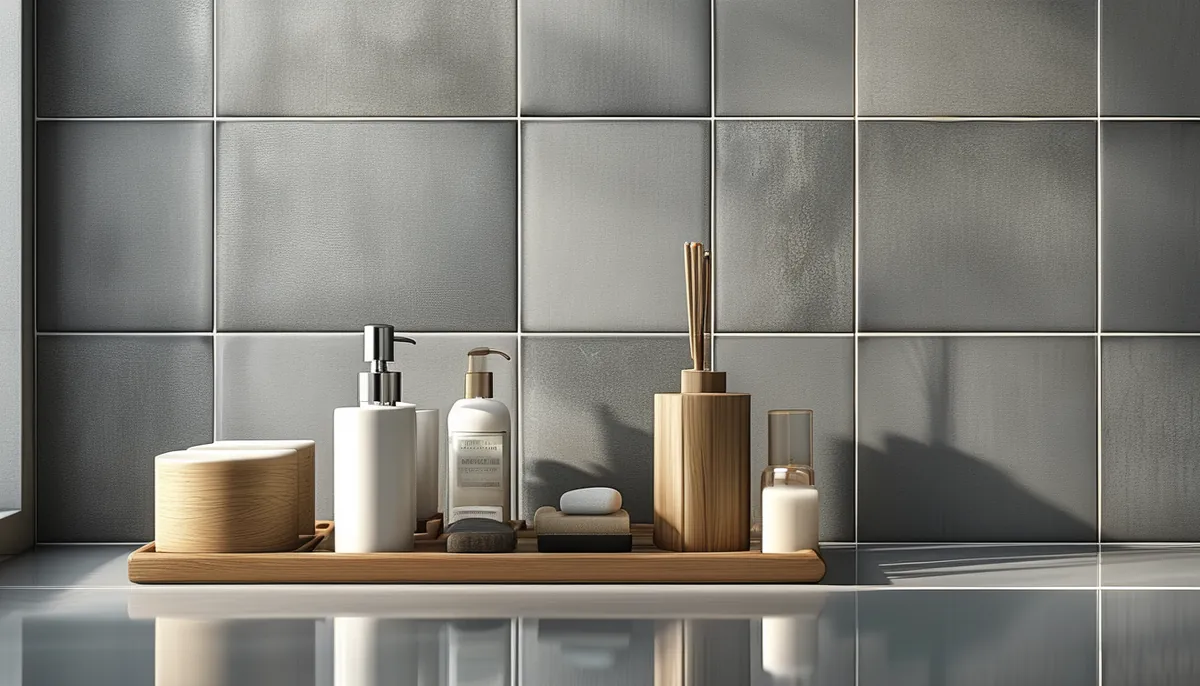
Depth is the number that decides whether a bathroom shelf stores anything. A folded hand towel is about 6 inches across. A bath towel folded in thirds and rolled is 7 to 9 inches. A standard shampoo bottle is 3 to 4 inches deep at the base and top-heavy. So a 4-inch shelf holds a candle and a small plant; a 6-inch shelf holds hand towels and toiletries; an 8 to 10-inch shelf holds rolled bath towels and baskets, and starts to feel intrusive in a room under 40 square feet.
Pick the depth from what you intend to store, then find a shelf in that depth, rather than buying a shelf you like and discovering it fits nothing.
Heights and clearances that stop a shelf being a hazard
Over a toilet, the lowest shelf should sit at least 24 inches above the tank lid, and you must be able to lift that lid straight up to reach the flush valve. Check the lid clearance with a tape measure, not by eye; a shelf at 20 inches makes every future repair a disassembly job. Keep the shelf depth here at 8 inches or less, since anything deeper is at head height for someone standing up from the seat.
Above a vanity, mount the first shelf 18 to 24 inches above the countertop. Below 18 inches you cannot stand a tall bottle underneath or use the faucet comfortably; above 24 inches on the wall you lose easy reach for anyone under about 5 foot 6.
Beside or over a tub, keep shelves out of the arc where someone stands up. Anything within the shower spray needs to be a material that drains and dries, and anything over the tub should be shallow, with a lip or rail if you are storing bottles.
Check the door swing before drilling. A shelf on the wall behind a door that opens flat against it is a shelf that will be destroyed by the door handle within a week. Open the door fully and mark where the handle strikes.
Between shelves, 12 to 14 inches of vertical spacing handles bottles and stacked towels. Eight inches is a display shelf, useful only for folded washcloths and small items.
Anchors: the part people get wrong
A bathroom shelf holds more weight than anyone estimates. A stack of four folded bath towels is 6 to 8 pounds. A ceramic canister full of cotton rounds is a few more. Add the leverage of a shelf projecting 8 inches from the wall and the pull-out force at the top anchor is several times the load sitting on it.
Into studs, when you can. Framing sits at 16 inches on center in most houses, and a magnetic or electronic stud finder will locate it through drywall. Two 2.5-inch screws into framing will hold anything a bathroom shelf will ever carry. The problem is that bathroom walls are short and the stud is rarely where you want the shelf.
Into hollow drywall, use toggle bolts or heavy-duty self-drilling metal anchors, never the small ribbed plastic plugs that come in the box with most shelves. Those plugs are rated for a picture frame. Look at the printed load rating on the anchor package, note whether it is a shear rating or a pull-out rating, and plan on half of it, because the rating assumes perfect installation in 1/2-inch drywall in a wall that never gets bumped.
Into tile, the method changes. Mark the hole with tape to stop the bit wandering, drill with a diamond or carbide bit at low speed with no hammer action and a little water to keep the bit cool, then switch to hammer mode only once you are through the tile and into masonry behind it. Drill through the center of a tile, never on a grout line at the corner of four tiles, and never within about an inch of a tile edge. A cracked tile in a finished bathroom is a repair with no good outcome.
One rule that overrides all of the above: do not drill into a wet wall until you know what is behind it. The wall behind a shower valve or under a sink contains supply lines. A stud finder with a live wire and metal setting is worth the twenty seconds.
Materials that survive a bathroom
Humidity in a bathroom with a daily shower cycles from ambient to near saturation and back, twice a day. Materials that shrug off a splash can still fail under that cycling.
Solid wood works if it is sealed on all six faces, including the ends and the underside, which is where installers cut corners. Teak and cedar handle it natively and are the traditional choice for a shower bench or a bath caddy.
MDF does not belong in a bathroom, and this includes most inexpensive painted floating shelves. It looks fine for two years, then the bottom edge swells where steam condenses and it cannot be repaired.
Metal comes down to the finish, not the metal. Stainless steel in a marine-grade alloy resists pitting near a shower. Chrome plating over steel is fine until the plating is chipped, at which point rust starts underneath and spreads. Powder-coated steel is durable and easy to touch up, matte black included, though it will show water spots in hard-water areas.
Glass shelves are practical in a small bathroom because they disappear visually. Specify tempered glass; for a span up to about 24 inches, 3/8 inch thickness is the sensible minimum, and thinner glass on a long span will flex. Polished edges are not a luxury on a shelf at head height.
PVC and WPC shelving is completely unaffected by water, cuts easily, and is the low-worry answer over a tub. It dents more easily than wood, so it is a better fit for storage than for a surface you lean on.
Match the shelf type to the problem
An over-toilet etagere or ladder unit adds three or four shelves in a footprint that was already dead space, and the freestanding versions need no anchors, though they should still be strapped to the wall in a household with kids. Look for one where the bottom opening clears the tank by a real margin, not the minimum.
Corner shelves solve the bathroom that has no free wall. A corner unit gains depth on the diagonal, so a corner shelf can be 10 inches deep on the diagonal while projecting only 7 inches from either wall.
A recessed niche is the best storage in any bathroom and the only kind that costs you no floor or wall projection. Between standard studs you have about 14.5 inches of clear width and 3.5 inches of depth, which is enough for bottles standing upright. It has to be waterproofed as part of the shower assembly, so it is a remodel decision, not a Saturday project.
Floating shelves give the cleanest look and require the most attention to anchoring, since all the load transfers through concealed rods or a hidden bracket. Buy one whose bracket is a steel plate with multiple fixing points, not a pair of thin pins.
Above the door is the forgotten wall. A single 8-inch shelf spanning the doorway holds spare towels and toilet paper in a bathroom with no closet, and nobody notices it is there.
Loading a shelf so it still looks like a bathroom
A 24-inch shelf holds about three groupings before it reads as clutter. Use closed containers for anything with packaging: a lidded box for cotton and swabs, a small basket for hair tools, a jar for anything loose. Packaging is what makes bathroom storage look chaotic, not the quantity of objects.
Keep the daily items at the front of the lowest shelf and the refills up high. Anything you use every morning that lives above shoulder height will end up on the counter permanently.
Leave one shelf less full than the others. A bathroom shelf that is 100 percent packed reads as a supply cabinet; the same shelf at about 70 percent reads as designed.
Installation, in order
Mark the height with a pencil and check it with a level, then hold the shelf up and live with the mark for a minute before drilling; shelves almost always want to go 2 inches higher than the first instinct. Locate studs and mark them. Choose anchors for the studs you did not find. Drill, mount the brackets, level the shelf itself rather than trusting the bracket holes, and load it gradually the first day so you can see whether anything is moving.
The two failures worth naming: hanging a heavily loaded shelf on plastic plugs, which pulls out of the drywall in a chunk and takes the paint with it, and hanging a wood shelf without sealing the cut ends, which swells within a year in a room where the shower runs daily. Both take ten extra minutes to avoid.