Start with what the room already gives you, because that is what a theme has to work with. Measure the floor area, the ceiling height, and the direction the main window faces. A 10 by 11 room with 8-foot ceilings and one north window cannot carry a dark saturated scheme without reading like a closet. A 14 by 16 room with 9-foot ceilings and south light will swallow a pale minimal scheme and look unfinished. Every theme below assumes you checked those three numbers first.
The five pieces every bedroom theme runs on
Whatever direction you pick, the same short list carries the room. Get these right and the theme reads clearly even with inexpensive fill pieces.
- The bed and headboard. A headboard is the largest vertical object in the room and sets the style faster than anything else. Standard headboard height runs 48 to 56 inches from the floor for a queen; king headboards often reach 58 to 62 inches. A platform bed sits the mattress 10 to 14 inches off the floor with no box spring, which lowers the whole visual mass and buys back several inches of apparent ceiling height in a room with 8-foot walls.
- Nightstands. Match the top surface to within about 2 inches of the mattress top. Too low and you cannot reach a glass of water; too high and the room looks bottom-heavy. A headboard and nightstand combination bought as a set solves proportion instantly, and it is the single easiest way to make a mixed-furniture bedroom look deliberate. Where floor space is tight, two floating shelves at 26 inches, mounted 18 inches wide, do the job in about 4 inches of depth.
- Lighting at three heights. One ceiling fixture is a hotel room. Add a bedside source at roughly 24 to 30 inches above the mattress and something low, like a lamp on a dresser. A large paper pendant hung to about 30 inches above the floor in a corner reads as sculpture and costs less than most floor lamps.
- Textiles. Bedding, one rug, and pillows. A rug under a queen should extend at least 18 to 24 inches past the sides and foot of the bed, which means 8 by 10 for most queens and 9 by 12 for a king. A 5 by 7 floated in the middle of the room is the most common sizing mistake in a bedroom.
- One wall treatment. Paint, wallpaper, paneling, or a mural on the headboard wall. This is where the theme becomes legible from the doorway.
Mid-century modern
Walnut tone wood, tapered legs, low profiles, and a palette anchored by one saturated color against warm neutrals. Teal is the workhorse here. On a headboard wall it holds up in both daylight and lamplight, and it sits well beside walnut without the muddiness that navy can pick up under warm bulbs. If a full wall of teal is more than you want, paint the wall behind the bed only and keep the other three in a warm off-white.
Geometric motifs belong to this theme more than any other: a diamond or elongated hexagon pattern on wallpaper, a wool rug with an angular field, or picture frame molding laid out in a rhythm of rectangles rather than the classic single row. Keep the geometry to one surface. Patterned wallpaper plus a patterned rug plus a patterned throw is three arguments in a room that has to help you sleep.
Lucite and clear acrylic solve a specific problem in this theme. A room with a heavy wood bed, a wood dresser, and a wood nightstand goes visually solid fast. A lucite bench at the foot of the bed or a clear-legged side table breaks that mass without adding another color. In a bedroom under 120 square feet, one see-through piece can be the difference between furnished and crowded.
Warm minimal and Japandi
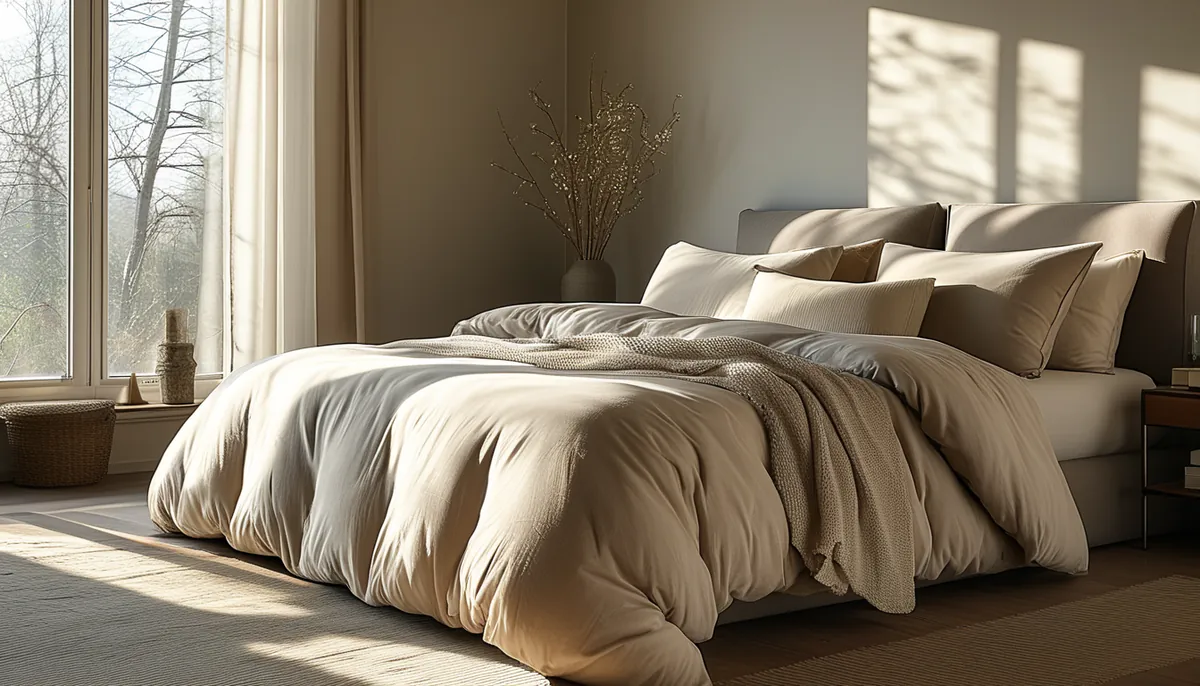
Low furniture, few objects, and texture doing the work that color does elsewhere. A platform bed at 12 inches, a single low dresser, oak or light walnut tones, and paper or linen shades. The palette runs from bone and oat through greige to a single grounding dark: charcoal, black oxide, or a deep olive on hardware and frames.
Texture is not optional in this theme, because without it the room is just empty. Use a grasscloth or woven-look wallcovering on one wall, a heavy linen duvet, and a low-pile wool rug. Wood slat paneling behind the bed, with slats around 1.5 to 2 inches wide at 2-inch spacing, gives vertical rhythm and quiets echo in a room with hard floors.
The discipline that makes it work: surfaces stay mostly clear. If your nightstand has to hold a phone, a book, a lamp, a glass, and a charger, choose a nightstand with a drawer and a shelf, not a bare pedestal you will bury within a week.
Layered boho
This is the theme where large-scale pattern earns its place. A big botanical or block-print motif with a 20 to 27 inch repeat covers a headboard wall in only a few strips and reads as one composition instead of busy wallpaper. Small repeats at this scale start to vibrate and look cheap from across the room.
Color block with quilts rather than buying a matched bedding set. Two solid or simple-pattern quilts in adjacent tones, folded in thirds and layered across the lower half of the bed, give you a controlled band of color that you can change seasonally for the cost of one textile. It also solves the boho failure mode, which is too many small patterns competing at eye level.
Natural fiber does the rest: a jute or seagrass rug as the base layer with a smaller flatweave on top, rattan or cane on one furniture piece, and a paper pendant overhead. Keep the wood tones within two families. Rattan plus oak plus walnut plus black metal is where these rooms tip into looking like a thrift haul.
Moody and saturated
Deep green, oxblood, ink blue, or a near-black on all four walls plus the ceiling. Painting only one wall dark in a small room makes it feel shallower; painting everything dark removes the corners and the room reads larger at night than you expect. This theme needs the light plan handled first. Plan on at least three light sources with warm lamps around 2700K, and put them on dimmers, because a dark room under one bright overhead is grim.
Contrast comes from material, not color. Brass or aged bronze hardware, a mirror with real weight, an upholstered headboard in velvet or a heavy textured weave, and white or bone bedding to keep the bed from disappearing. Picture frame molding painted the same color as the wall adds shadow lines that keep a dark surface from going flat.
The honest caveat: this theme is unforgiving in a room with one small window and no lamp budget. If you cannot commit to the lighting, take the same palette and use it on the headboard wall and textiles against a warm mid-tone on the remaining walls.
Coastal, farmhouse, and the trap they share
Both of these read as a theme through millwork more than through decor objects. Board and batten to 40 to 48 inches with a top cap, shiplap on the headboard wall, or beadboard behind the bed does more for either theme than any number of signs, jars, or rope-wrapped accessories. Set batten spacing by dividing the wall width into equal bays of 12 to 16 inches so you never end with a sliver at one corner.
The trap is literalism. A coastal bedroom does not need anchors, and a farmhouse bedroom does not need lettering on the wall. Get the millwork, the palette, and one or two natural materials right, then stop. A restrained version of either theme survives five years; the literal version looks dated in eighteen months.
What changes in a bedroom under 120 square feet
In a 10 by 11 or 11 by 11 room, the theme survives but the furniture list shrinks. Skip the bench and the second dresser. Use wall-mounted lights instead of table lamps to free up nightstand tops. Choose a platform bed with drawers underneath rather than a bed plus a dresser. Keep at least 24 inches of clear walking width on both sides of the bed if two people use it, 30 inches if you can get it, and 36 inches at the foot if a doorway or closet swings into that path.
Large-scale pattern still works in a small bedroom, but confine it to the headboard wall and keep the other three walls flat and light. Wall-to-wall pattern in a small room is a choice some people love and most regret after a month of waking up inside it.
Buy in this order
Paint or wallcovering first, while the room is easy to move around in and drop cloths are simple. Bed and headboard second, because the room’s proportions depend on them. Rug third, sized to the bed rather than to the room. Lighting fourth. Everything else after you have lived with it for two weeks.
The single most expensive reversal is buying furniture before deciding the wall treatment. A walnut mid-century bed pushes you toward teal, warm neutrals, and geometric pattern; a white upholstered platform bed opens the door to almost anything. Pick the theme, commit the walls, and let the furniture follow.