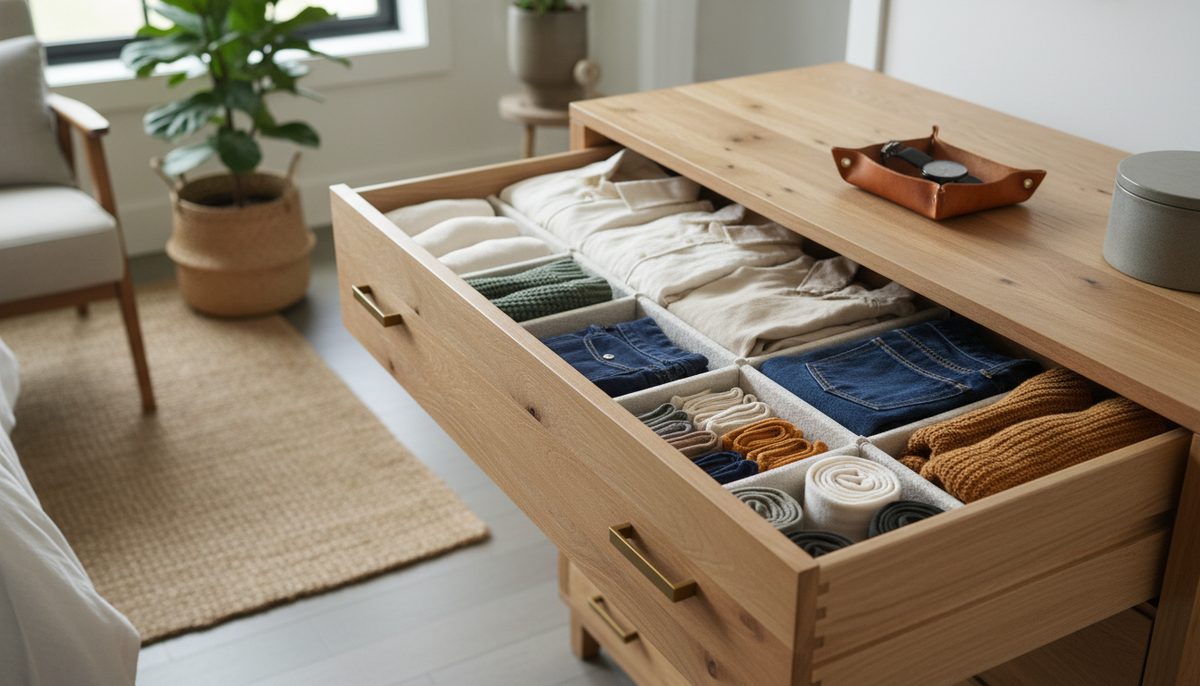
Pull a drawer completely out and flip it over. That single move answers most of what a product listing will not: how the box is joined, what the bottom is made of, how the slides mount, and whether anyone at the factory expected the drawer to hold sweaters or just to look closed in a photograph.
Joinery, in descending order of how long it lasts
The corners of a drawer box take every bit of force you apply when you yank a stuck drawer. How they are joined is the clearest single predictor of lifespan.
- Through dovetails or half-blind dovetails interlock the front and side with wedged fingers. They cannot pull apart in the direction of the pull, and they survive decades of use. English dovetails put the joint on the drawer side; French dovetails put a sliding joint under the front. Both are good news.
- Doweled or mortised joints with glue are a legitimate middle tier. They hold well as long as the glue joint stays intact and the drawer is not overloaded.
- Rabbeted and stapled or nailed joints rely on fasteners in end grain. They loosen. When a drawer front starts to separate from the sides after a few years, this is nearly always why.
- Butt joints with staples through particleboard are the bottom of the market. Particleboard has no fiber strength for a fastener to bite, so the joint fails as soon as it takes a real load.
A separate applied drawer front screwed onto a solid box is not a red flag; it is how most quality casework aligns fronts perfectly. What matters is the box behind it.
Bottoms, backs and the parts you never see
Drawer bottoms are where cost gets cut quietly. A 1/4-inch plywood bottom captured in a groove on all four sides will hold a load of folded denim without sagging. A 1/8-inch hardboard bottom stapled to the underside of the sides will bow within a year, and once it bows the drawer starts to bind on the frame below it.
Check three more things while the drawer is out:
- Dust panels. Thin horizontal panels between drawers keep dust out and add rigidity to the case. Their absence is common and not fatal, but their presence tells you the maker was not counting pennies.
- The case back. A solid or thick plywood back screwed into rabbets keeps the case square. A thin fiberboard back stapled on will let the whole piece rack into a parallelogram, after which the drawers never sit flush again.
- Interior finish. A sealed or finished drawer interior resists moisture and does not shed dust onto clothing. Raw particleboard interiors also carry a smell that never fully goes away in a closed drawer.
Slides: the part that decides how it feels
The slide mechanism accounts for most of the difference between a dresser that feels expensive and one that does not.
Wood-on-wood runners are traditional and can be excellent in solid hardwood casework, especially with a center guide underneath. They stick in humid weather and want a rub of paraffin once a year.
Epoxy-coated roller slides are the white metal slides on most budget furniture. They extend about three quarters of the way, they clatter, and they typically carry ratings in the 35 to 75-pound range. Their real weakness is that the drawer must be lifted slightly to come out, and they let the box tilt down when extended.
Ball-bearing full-extension slides bring the entire drawer clear of the case, which means you can actually reach the back. Look for a 75 or 100-pound rating on a dresser drawer. Full extension matters more than it sounds: on an 18-inch-deep drawer, three-quarter extension leaves 4 to 5 inches you will never comfortably use.
Undermount soft-close slides hide the hardware below the box, so you see clean wood sides, and they damp the last inch of travel. They demand tighter tolerances, which is why they mostly appear on better-built cases.
Test by opening a drawer to full extension and pressing down on the front corner. A well-built drawer barely moves. A cheap one dips and the slide flexes visibly.
Sizes, clearances and how many drawers you need
Standard dimensions are fairly consistent across the US market, which helps in planning a room:
- Horizontal dresser (double dresser): 30 to 36 inches tall, 18 to 20 inches deep, 52 to 66 inches wide, usually six to nine drawers in two or three banks.
- Chest of drawers (tallboy): 40 to 54 inches tall, 16 to 20 inches deep, 30 to 40 inches wide, five to six drawers stacked.
- Bachelor chest or small chest: 30 to 34 inches tall, three to four drawers, useful where a nightstand is too small.
Two clearances get overlooked. You need the drawer depth plus 12 inches of standing room in front, so a 20-inch-deep dresser with full-extension slides wants roughly 36 inches of clear floor to be pleasant to use. And a dresser under a window should stop below the sill, while one under a wall-mounted TV needs the top surface at least 6 inches clear of the screen bottom for anything to sit there.
On drawer count, deep is better than many for bulky items. Two 10-inch-deep bottom drawers hold more usable sweater volume than four 5-inch drawers of the same footprint, because folded stacks need height. Shallow top drawers, 4 to 5 inches, are right for socks, underwear and small accessories, where depth just means digging.
Case material, and where solid wood actually matters
Solid hardwood throughout is the durable choice, and it is also heavy and expensive. Most well-made dressers today mix materials sensibly: solid wood for the frame, legs and drawer boxes, and veneered plywood for the large flat panels of the top and sides. That is not cost-cutting. Wide solid panels expand and contract seasonally and can crack; a veneered plywood panel stays flat.
The combination to avoid is veneer or printed paper foil over particleboard on structural parts. Particleboard swells irreversibly when it meets water, and screws stripped out of it cannot be reset without an insert. A quick way to check: look at the underside of the top and at an unfinished edge inside the case. Plywood shows layered plies; particleboard shows compressed chips; MDF shows a smooth uniform brown.
Anchor it before you fill it
A loaded dresser with two drawers open has its center of gravity forward of its front feet, and a child climbing an open drawer can bring it over. Every dresser sold in the US now ships with a tip restraint, and it works only if it is screwed into framing.
Fasten the strap to a wall stud with the screw provided, not into drywall alone and not into a hollow anchor rated for picture frames. Find the stud with a magnet locating the drywall screws if you do not have a stud finder. If the dresser cannot sit against a stud, use a toggle-style anchor rated for at least 100 pounds in shear and check it once a year, since the strap loosens as the furniture is nudged.
Two loading habits also help: keep the heaviest items in the bottom drawers, and never leave more than one drawer open at a time in a room a child uses.