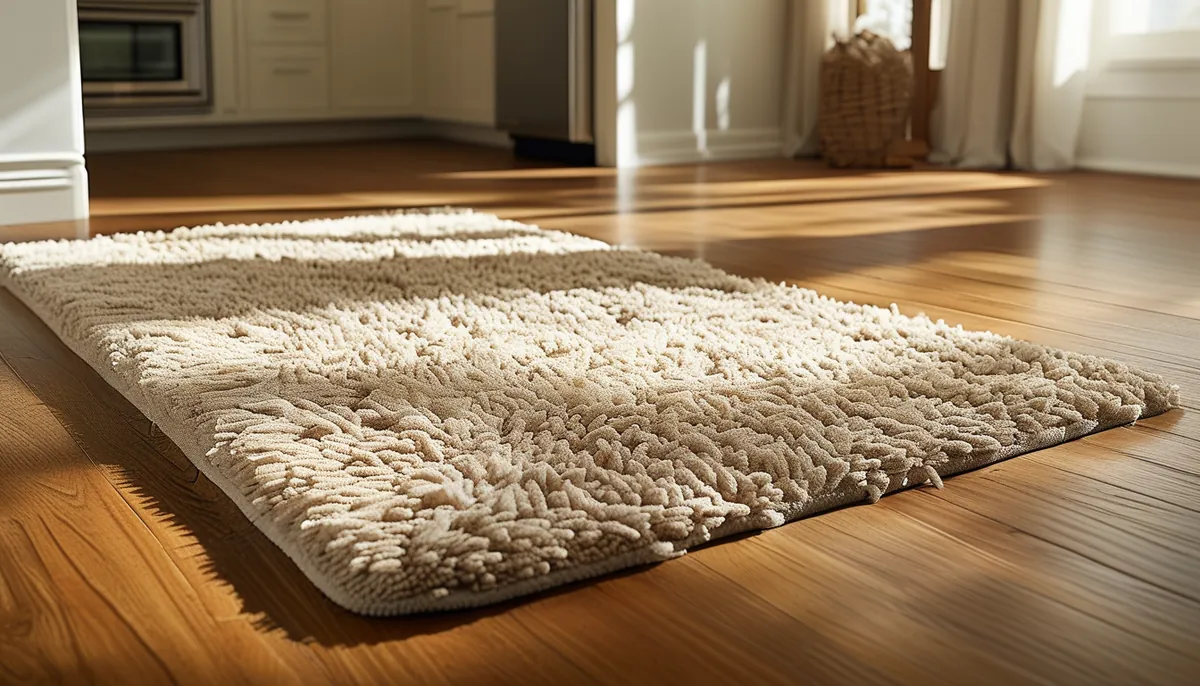
Kitchen carpet rugs get chosen the way throw pillows get chosen — by color, in a hurry. Then the dishwasher door hits the edge, the corner curls under a barstool, and the whole thing gets rolled up in a closet by spring. Size and pile height decide whether a kitchen rug lasts. Pattern is the last decision, not the first.
Sizes that fit a real kitchen layout
Kitchens are corridors with appliances, so most kitchen rugs are runners, and the length is set by the walkway, not by taste.
- In front of a single sink: a 2-by-3-ft mat covers the drip zone. A 2-by-6-ft runner covers sink plus dishwasher, which is usually the better call because it eliminates the visual break between two small mats.
- Galley kitchen: measure the clear walkway and subtract 12 to 18 in total, leaving 6 to 9 in of bare floor at each end. A runner that runs wall to wall looks installed rather than placed, and the ends get kicked up.
- Island runs: the runner should be at least as long as the island and ideally 12 to 24 in longer, split evenly past both ends. A runner shorter than the island makes the island look longer and the rug look accidental.
- L-shaped kitchens: use two runners, one per leg. A single rug forced around a corner never sits flat and telegraphs every step.
- Eat-in table: the rug must extend 24 in past the table edge on all four sides so the back legs of a pulled-out chair stay on the rug. Anything less and every chair catches the edge.
Leave 3 to 6 in of visible floor between the rug and the cabinet toe kick. Pushing the rug tight to the cabinets traps crumbs underneath and makes the kitchen read narrower than it is.
Pile height is a clearance problem
A kitchen has more swinging and rolling hardware at floor level than any other room, and most of it has less than an inch of clearance.
Keep total thickness — rug plus pad — under 1/2 in. Under 1/4 in is safer. A dishwasher door drops nearly to the floor when open, an oven door does the same, and a lower cabinet drawer front often clears by less than 3/8 in. If a rug will sit directly in front of an appliance, either hold it back 2 in from the appliance face or go flatweave.
Interior door undercuts are typically 1/2 to 3/4 in above finished floor, which a shag or thick tufted rug will not pass under. High pile also loses on function: crumbs and grease sit down inside the yarn where a vacuum without a beater bar cannot reach them, and barstool legs snag the loops.
Flatweave, low-loop, and machine-washable woven cotton in the 1/8 to 1/4 in range are the practical range for a working kitchen.
Fibers, ranked by how they handle grease and water
Kitchen soil is different from living room soil. It is oil-based, and oil is what separates the fibers that work from the fibers that look good for four months.
- Polypropylene (olefin): essentially non-absorbent, cleans with diluted bleach without losing color, and costs the least. It crushes flat under sustained traffic, so plan on replacing it rather than reviving it. For most kitchens this is the correct trade.
- Nylon: the best crush recovery of any synthetic and it takes stain treatments well. Costs more, and worth it in a kitchen that gets heavy daily standing at the sink.
- Polyester (PET): deep color and soft hand, but it is oleophilic — it grabs and holds oil-based stains, which is precisely the stain a kitchen manufactures. Keep it away from the range.
- Wool: naturally resists soil and springs back from crushing, but it absorbs water and stains readily from tomato, wine, and turmeric. Fine in an eat-in dining zone, poor in front of a sink.
- Cotton flatweave: the honest sink rug, because it goes in the washing machine. Accept that it will look tired within a year and price it accordingly.
- Jute and sisal: the worst choice near water. Both wick moisture, brown out where they stay damp, and cannot be scrubbed without fraying.
- Indoor/outdoor flatweave: polypropylene woven for exterior use. It can be taken outside and hosed down, which is a real advantage in a kitchen with kids.
Rug pads, slip resistance and one warning about vinyl floors
Any rug on a hard floor needs a pad. Without one the rug slides, and a sliding rug on a tile or plank floor next to a hot stove is the actual safety issue in this room, not the rug itself.
Use a felt-and-natural-rubber pad. Pick 1/4 in for cushion where clearance allows, and 1/8 in where an appliance door is in play. Cut the pad 1 in smaller than the rug on all sides so it disappears under the edge instead of peeking out and catching feet.
On luxury vinyl plank, SPC, and sheet vinyl, use only pads labeled as natural rubber or felt with natural rubber backing. Inexpensive PVC-coated and adhesive-tack pads can react with the wear layer of a vinyl floor and leave permanent yellow or dark staining that no cleaner removes. The same caution applies to rubber-backed rugs that are sold as non-slip on their own — that backing also dries out, cracks, and sheds a gritty residue after a couple of years.
One more vinyl-floor detail: a rug left in one place for years next to a sunny window creates a UV shadow. When you eventually move it, the floor underneath is a lighter rectangle. Rotate kitchen rugs a couple of times a year.
Anti-fatigue mats are a different product
If someone in the house stands at the sink or the range for 30 minutes at a stretch, a rug is not the answer. A polyurethane foam anti-fatigue mat, commonly 3/4 in thick with a beveled edge, does something a woven rug physically cannot: it lets the foot micro-adjust and takes load off the lower back.
The trade-offs are real. It cannot go in a washing machine, it only wipes clean, and 3/4 in is a genuine trip edge — which is why the beveled perimeter is not optional. Some kitchens end up with both: a foam mat at the prep station and a washable runner along the walkway.
Patterns and colors that hide what a kitchen does
Solid cream shows every crumb and every drop of coffee. Solid black shows lint, flour, and pet hair even more clearly. The forgiving middle is a mid-tone multicolor or a small-scale repeating pattern, which breaks up soil visually until the next wash.
Tonal stripes work well in a runner because they emphasize length, which is what you want in a galley. Large-scale patterns fight with a busy backsplash and a run of cabinet hardware; if the kitchen already has pattern on the wall, keep the floor quiet and textural.
Match the rug’s undertone to the cabinets and countertop, not to the wall paint. Cabinets and counters occupy far more visual field in a kitchen, and a warm-cream rug against cool-gray cabinets looks like a mistake from the doorway.
Cleaning, and what to check before you buy
Shake or vacuum flatweaves weekly, with the beater bar off so it does not fuzz the surface. Blot grease immediately with a few drops of dish soap in warm water, working from the outside of the spot inward. Rotate the rug end for end every few months so traffic wear spreads evenly.
Before ordering a washable rug, check its listed weight and your washer capacity. Many 2.5-by-8-ft runners exceed what a standard top-loader can handle wet, and a rug that only fits a commercial machine is a rug you will stop washing.
Three mistakes account for most kitchen rug regret: buying a size that blocks an appliance door, skipping the pad, and choosing a fiber that loves oil. Sort those three and the rug you like will still be there in three years.