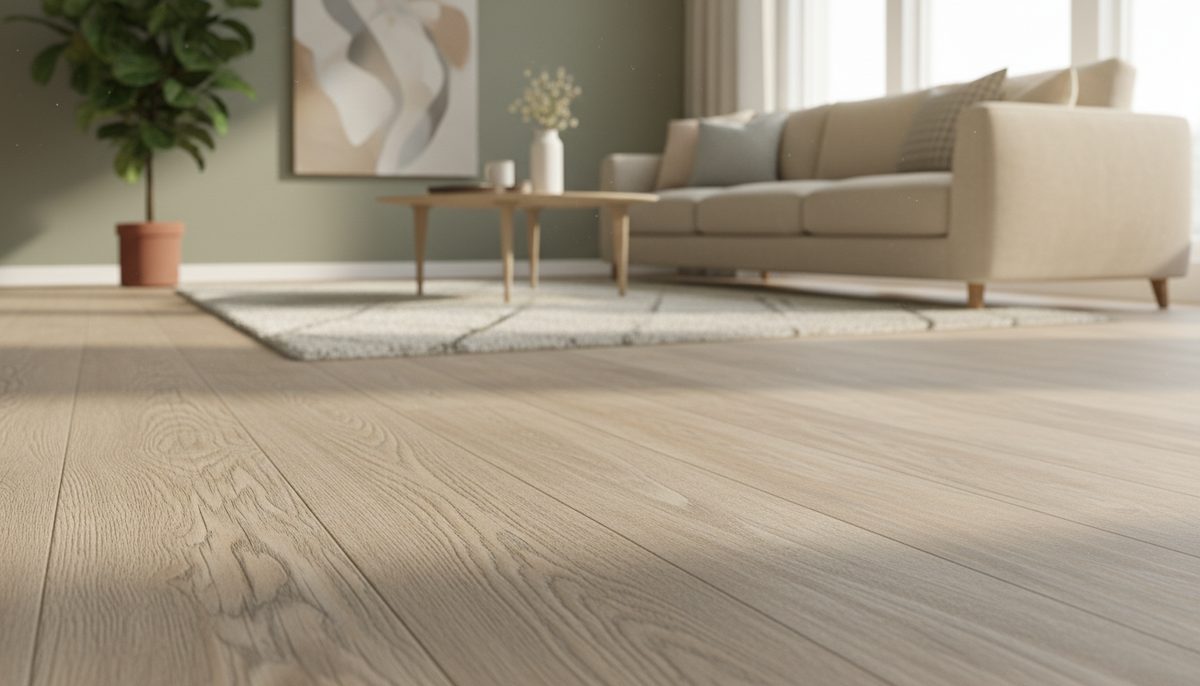
Vinyl plank gets sold as waterproof flooring, and that phrase does more damage than any other in the category. The plank is waterproof. The floor is not. Water that crosses a click seam sits on the subfloor underneath with nowhere to evaporate, and the first sign is a musty smell weeks later, not a visible problem. Understanding the difference between a waterproof material and a waterproof assembly is most of what you need to choose the right rooms for it.
The rooms where vinyl plank is the right call
Basements are the strongest case. Concrete slabs release moisture vapor for years, sometimes forever if there is no vapor barrier under the slab, and that vapor destroys engineered wood and swells laminate. A rigid-core SPC plank floating over a 6-mil poly vapor barrier tolerates it. Test the slab first with a calcium chloride or relative humidity test, or at minimum tape a 2-by-2-foot square of plastic sheeting to the slab for 72 hours and check for condensation underneath. If you see moisture, the barrier is mandatory, not optional.
Kitchens and laundry rooms are good candidates because spills are frequent, brief, and cleaned up. A dishwasher that dumps 2 gallons is a different event, and no floating floor handles that well, but neither does laminate or an unsealed wood floor.
Rentals and flips make sense on the arithmetic. Plank is fast to install, individual boards can be swapped, and it does not need refinishing between tenants.
Homes with dogs do well with it. Claw scratching shows less on a textured plank with a 20 mil wear layer than on any site-finished hardwood, and accidents do not stain the way carpet does.
The rooms where it is the wrong choice
Sunrooms and any room with large south or west-facing glass are the number one failure. Vinyl expands with heat, and a floating floor sitting in direct sun for six hours a day can gain enough length to buckle at a doorway if the expansion gap was undersized. Some products have restrictions or reduced warranty coverage for direct sunlight and unconditioned spaces, so read the warranty before buying rather than after. If the room is going to bake, either use a glue-down plank, which cannot move, or use tile.
Unconditioned spaces have the same problem in reverse. A three-season porch that swings from 30 degrees F in January to 100 degrees F in July puts a floating floor through a large annual cycle. Glue-down or nothing.
Stairs are workable but they are not a beginner job. Plank on treads needs a stair nose profile, full adhesive, and mechanical fastening at the nose; a click floor floated over a stair tread is a real fall hazard. Price the nosing pieces before committing, because on a 14-step run they can rival the cost of the field material.
Bathrooms with a curbless shower or a floor drain are also a poor fit. That floor is designed to get wet on purpose, and the correct assembly is tile over a waterproofing membrane.
What actually fails, and in what order
Peaking and gapping at the walls comes first, usually within the first summer. The cause is almost always an expansion gap that was too small or was filled by something rigid: a baseboard nailed through into the plank, a toilet flange, a heavy kitchen island bolted down, a door casing that was never undercut. Most manufacturers call for roughly 1/4 to 3/8 inch of gap at every vertical surface; the exact figure is in the installation instructions and it varies with run length. The baseboard covers it, so nobody sees it, and skipping it is the single most common install error.
Telegraphed subfloor comes second. Rigid core planks bridge a hollow instead of following it, so a 1/4-inch dip over 6 feet shows as a soft spot that clicks underfoot and eventually stresses the locking edge until it separates. Most instructions require flatness within about 3/16 inch over 10 feet. Check with a straightedge and fill the lows with a cementitious patch before a single plank goes down.
Wear-through appears in year three or later, and only where the traffic is. It concentrates at the pivot points: in front of the sink, at the bottom of the stairs, inside the door from the garage. A 6 mil wear layer will not survive those spots; 20 mil will. Buy the wear layer for your worst room, not your average one.
Indentation from furniture is the quiet one. A flexible LVT with a soft core takes a permanent dent from a refrigerator leg or a piano caster. Wide non-staining floor protectors, at least 1 inch of contact per 100 pounds as a working rule, keep it from happening. Rubber-backed mats are a separate hazard: some rubber and latex backings react with vinyl and leave a yellow stain that no cleaner removes.
Cost drivers that are not the plank price
Subfloor preparation is the line item that moves. Grinding high spots and patching lows on an out-of-flat slab, or screwing down and leveling a squeaky plywood subfloor, can take longer than the flooring install itself.
Transitions and trim add up faster than people expect. Every doorway needs a T-molding or a threshold, every step-down needs a reducer, and each room boundary is a piece. Count the openings in your plan and price the profiles individually.
Removal and disposal of the old floor matters if you have glued-down sheet vinyl or ceramic tile. Tile removal on a slab is loud, dusty, multi-day work, and it may leave thinset that needs grinding.
Underlayment is either included as a pad attached to the plank or purchased separately, and doubling up is a mistake: an attached pad plus a separate foam underlayment makes the assembly too soft and stresses the click joints. Pick one.
Waste factor should be 7 to 10 percent for a straight layout in rectangular rooms, and 15 percent for diagonal layouts or floor plans with many small rooms and closets.
Living with it: cleaning and repair
Dry cleaning first, always. Grit is what abrades a wear layer, so a vacuum with the beater bar off, or a microfiber dust mop, does more for the floor’s life than any cleaner.
Damp mop, never wet mop. A floating floor with standing water on it lets water find the seams. A microfiber pad wrung nearly dry and a neutral pH cleaner is the whole routine. Skip steam mops entirely; the heat can soften the wear layer and the pressure drives moisture into seams.
Do not use oil soaps, wax, or anything that leaves a film. Vinyl already has a finished surface, and a film on top of it dulls unevenly and cannot be stripped without damaging the plank.
For repair, a glue-down floor is the easiest: heat the damaged plank with a heat gun to soften the adhesive, lift it, scrape the substrate, and set a new one. A floating click floor either gets disassembled back to the damaged board from the nearest wall, which is quick if it is three boards in, or gets a cut-out repair where you cut the damaged plank out with a track saw and glue a replacement in with the locking edges trimmed off. Keep one unopened carton from the original run in a closet. Color and gloss shift between production runs, and a plank bought two years later rarely matches.
How to compare two products on the shelf
Ask for the wear layer in mils, not the total plank thickness. Total thickness tells you how it feels underfoot; only the wear layer predicts how it ages.
Ask whether the core is SPC, which is stone-plastic and rigid, or WPC, which is wood-plastic and slightly softer and warmer, or flexible LVT, which needs a near-perfect subfloor and is usually glued. Rigid cores are more forgiving of subfloor imperfection and less prone to thermal movement; softer cores are quieter and more comfortable to stand on.
Look at the pattern repeat. Cheap product uses four or six unique board images for the whole floor, and you will see the same knot three times in one sightline. Better product runs 12 or more. Lay eight planks out in the store and look for the repeat before you buy.
Check the bevel. A painted micro-bevel wears through at the edge and shows a light line. A true embossed or pressed bevel does not.
Finally, read the warranty for what voids it. Direct sunlight limits, temperature ranges, required underlayment, required expansion gaps and moisture testing on slabs are all in there, and every one of them is a condition you have to meet on install day, not later.