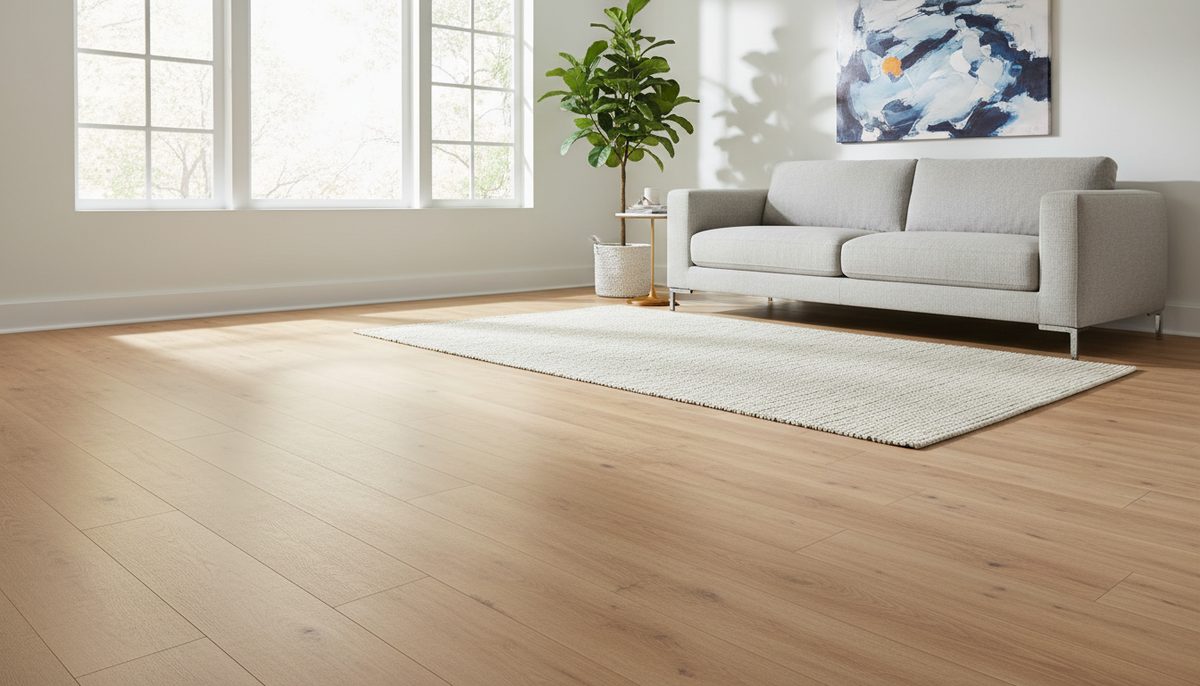
A laminate floorboard is four layers pressed together: a melamine wear layer with aluminum oxide in it, a printed decor paper, a high-density fiberboard core, and a balancing backer that keeps the board from cupping. Almost everything that matters about how the floor performs is decided by two of those layers, and neither one is visible on the showroom sample.
AC rating is the number to read first
Abrasion Class is a standardized durability grade covering wear, impact, staining, and burn resistance. It runs from AC1 to AC6 and it is printed on the carton, not always on the sample board.
- AC1 and AC2 are light residential. Closets, guest bedrooms, a home office nobody enters in shoes. Putting AC2 in a hallway is how people conclude that laminate does not last.
- AC3 is general residential and light commercial. This is the practical minimum for a living room, kitchen, or any room with a door to the outside.
- AC4 handles heavy residential and moderate commercial traffic. Worth the premium in an entry, a family room with a dog, or a rental unit.
- AC5 and AC6 are commercial grades. Overkill in a house, but relevant if you have a home gym or a mudroom that takes cleats and bike tires.
The wear layer is what the AC rating measures, and it is independent of how thick the board is. A 12 mm AC3 board will show traffic paths before an 8 mm AC4 board in the same hallway. Thickness buys you rigidity, sound, and the feel underfoot. AC rating buys you years.
Core density predicts everything about the joints
The core is HDF, and HDF quality varies more than any other component. Density is stated in kilograms per cubic meter, and better residential laminate typically sits above roughly 850. Denser cores machine a crisper locking profile, resist edge crush when a chair leg drags across a seam, and swell less if water sits on a joint.
You can screen for it without a data sheet. Take two sample boards and press a thumbnail hard into the milled tongue on the edge. A dense core resists and leaves almost no mark; a cheap one dents. Then click two samples together and try to twist them apart by hand. A well-milled joint holds and releases with a definite motion. A soft one feels vague, and that vagueness becomes a visible gap along a 20-foot run after one heating season.
Water-resistant and waterproof laminate is now common, and the terms are not interchangeable. Water-resistant usually means a treated core plus a wax or sealant on the edges that buys you a window, often stated as 24 or 72 hours, to wipe up a spill. Waterproof claims typically involve a different core material entirely or a coated board with sealed joints, and the warranty language usually still excludes standing water and flooding. Read what the warranty covers rather than what the marketing says, because with a fiberboard core, water sitting in a seam overnight is what causes the swollen edges that cannot be repaired.
Thickness, plank size, and how the floor reads
Common thicknesses are 7, 8, 10, and 12 mm, sometimes with an attached pad included in the stated number, which is a detail worth checking because a 12 mm board with a 2 mm pad is a 10 mm board.
Thicker boards feel more solid and sound less hollow, mainly because they bridge minor subfloor irregularities better. They also raise the finished floor height, which affects door clearance, appliance height under a counter, and the transition to adjacent rooms. A dishwasher installed under a countertop before a 12 mm floor goes in may no longer come out afterward, and that is a genuinely expensive surprise.
Plank dimensions changed the look of laminate more than any technical improvement. Long, wide boards, commonly 7 to 9 inches wide and 48 to 72 inches long, mean fewer visible seams and a floor that reads closer to real plank flooring. Narrow strip laminate in 5-inch widths reads busier and older. In a small room, longer boards can be harder to handle around corners, and they demand a flatter subfloor because there is less opportunity for the floor to follow a dip.
Edge treatment is the other visual decision. A painted micro-bevel on all four sides gives each board a defined outline and hides small height differences between planks. It also collects dust and mop grit in a kitchen. Square-edge boards present as a more continuous surface and clean more easily, but any height variation between adjacent planks shows immediately, which raises the bar on subfloor prep.
Surface texture matters for a different reason: an embossed-in-register finish, where the texture aligns with the printed grain, holds up visually far better under raking light than a generic all-over emboss that repeats every third board. Lay six sample boards on the floor and look for the repeat. A pattern that repeats every three or four boards will be obvious across a whole room.
Subfloor flatness and underlayment
Laminate is a floating floor, which means the board assembly rests on the subfloor without being fastened to it. Manufacturers generally require flatness within about 3/16 inch over a 10-foot span. Check it with a long straightedge, marking hollows and high spots in chalk before anything gets ordered.
Hollows cause the two symptoms everyone complains about. The floor sounds hollow underfoot, and the locking joints flex with every step until the tabs fatigue and separate. Fill hollows with a cementitious patch or a self-leveling underlayment; sand high spots on plywood and grind them on concrete.
Underlayment does three jobs: cushioning, sound attenuation, and vapor control. Boards with an attached pad already handle the first two at a basic level, and adding a second foam layer under them is a mistake, since too much compressible material under a floating floor overworks the joints. Over concrete, a 6 mil polyethylene vapor retarder is standard, taped and lapped up the wall behind the baseboard, unless the attached pad already includes a moisture barrier. Doubling up barriers traps moisture between them.
Laminate cannot go over carpet, over a second floating floor, or over an unsealed slab with a moisture problem. Test a slab before committing: taping a 2-foot square of plastic sheeting down for 48 hours and checking for condensation is a screen, but a calcium chloride test or an in-slab relative humidity probe gives a number the manufacturer’s specification can be compared against.
Expansion gaps, run length, and the details that get skipped
A floating laminate floor expands and contracts with humidity across the whole field, not board by board. That movement has to go somewhere.
- Leave the specified perimeter gap, typically 1/4 to 3/8 inch, at every wall, cabinet toe kick, pipe, and door casing. Baseboard and quarter round cover it. Skipping the gap produces peaking, where the field has nowhere to go and a seam lifts into a ridge in August.
- Respect the maximum continuous run. Many products cap it around 40 feet in either direction, past which you need a T-molding. Open floor plans exceed that easily, and installers who dislike a transition strip in the middle of a great room sometimes skip it. That is the buckle at the kitchen doorway.
- Undercut door casings with a jamb saw and slide boards underneath rather than scribing around them. Fifteen minutes per door, and it is the visible difference between a professional and an amateur floor.
- Stagger end joints at least 8 to 12 inches, and never let three rows form a stair-step. Work from three or four cartons at once so print repeats do not cluster.
- Acclimate the cartons flat in the room, typically 48 hours at normal living temperature and humidity. Boards installed cold and dry will expand later, and that is the same failure as no expansion gap.
Living with laminate floorboards
Laminate cannot be refinished. The image is a printed paper under melamine, and once you wear through it, the only repair is replacing boards, which on a floating floor means unclicking rows back to the damage or cutting a board out and gluing a replacement in. Keeping a carton of spares from the original run is the cheapest insurance you can buy, because dye lots and product lines both change.
Cleaning is where people damage laminate without realizing it. Dry sweep or vacuum with the beater bar off, then damp mop with a barely wet microfiber and a cleaner labeled for laminate. Never wet mop, and never use a steam mop: steam drives water directly into the seams, and a swollen core edge is permanent. Grit is the real wear mechanism, acting as sandpaper on the melamine, so a walk-off mat at every exterior door extends the floor’s life more than an extra AC grade would.
Felt pads under every furniture leg, wide casters or a chair mat under office chairs, and a policy against dragging appliances across the surface handle the rest. Laminate resists scratching well and resists gouging poorly, and the difference between the two is a hard point load being dragged rather than set down.