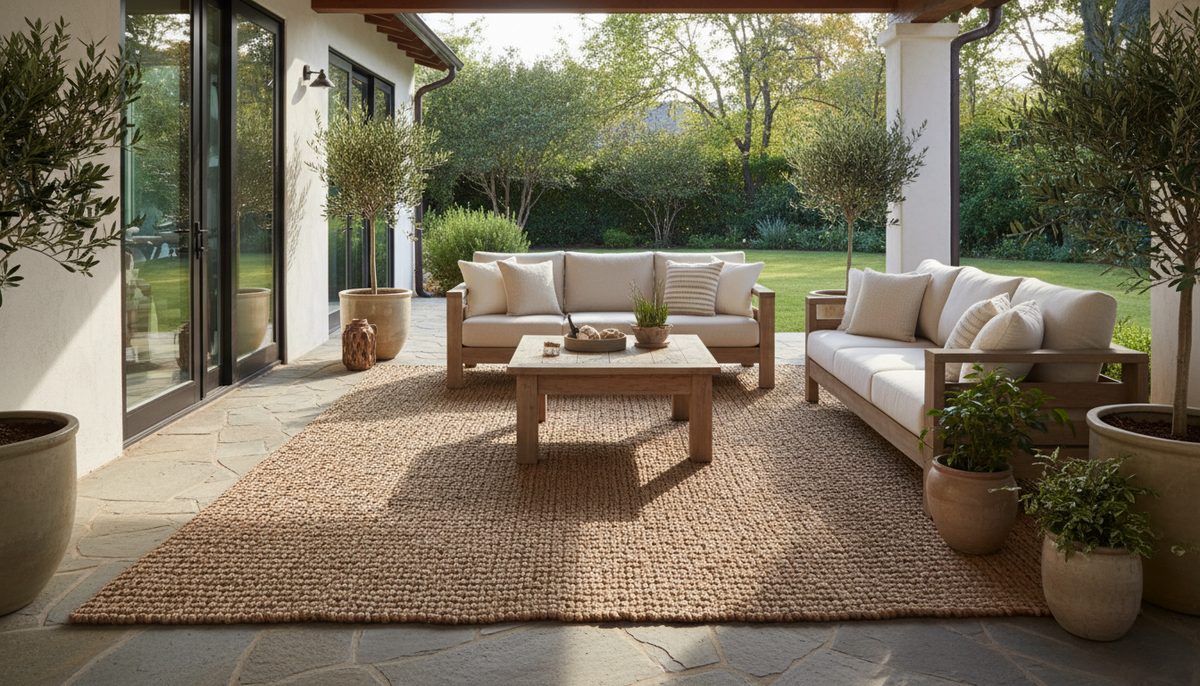
The rug is rarely what fails outdoors. The backing is. A rug with a solid latex or rubber backing laid on a wood deck holds a film of water against the boards after every rain, and within one season you have a rectangle of gray, soft, sometimes rotting wood in the exact shape of the rug. Everything else about outdoor rug shopping is secondary to whether the thing can drain and dry.
Fibers, ranked by how they behave outside
Polypropylene, also sold as olefin. The default outdoor fiber, and for good reason. It is solution dyed, meaning color goes into the fiber as it is made rather than being applied to the surface, so it resists fading and bleach. It absorbs almost no water, under one percent, so it dries fast and does not support mildew on its own. It is inexpensive. The tradeoffs: it flattens under heavy furniture legs and does not spring back, and it has a low melting point, so a dropped grill ember or a hot fire pit spark leaves a permanent glazed spot.
PET, recycled polyester. Softer underfoot than polypropylene and often more attractive in a low-pile weave. Good stain resistance to water-based spills and reasonable UV performance. It holds oils, though, so sunscreen and grill grease are harder to get out than they would be on olefin.
Nylon. The most resilient fiber, meaning it recovers from crushing better than anything else, which matters under a dining table where chairs move constantly. It also fades faster in direct sun unless it is solution dyed, and it absorbs more moisture than the polyolefins. It belongs on a covered porch rather than an exposed patio.
Natural fibers. Jute, sisal, seagrass and cotton are outdoor rugs in photographs only. They absorb water, they mildew, they stain from a single rain, and jute in particular breaks down when repeatedly wet. A covered porch under a deep overhang in a dry climate is the only place they last, and even there they will not survive a sprinkler.
Vinyl and PVC flatweaves. Woven vinyl strands over a polyester core. They hose off completely, resist stains almost entirely, and last a long time in sun. They are also hard underfoot and can get slick when wet, so they are better in a dining zone than around a pool.
Construction and backing
Three constructions dominate, and they are not interchangeable.
Flatweave rugs have no pile and no separate backing. Water passes straight through, they dry in an hour, they are light enough to shake out, and they lie flat under furniture. This is the safest choice on a wood deck and the most practical almost everywhere else.
Machine-tufted rugs with a scrim backing have a short pile stitched into a woven backing. Look for a permeable scrim rather than a sealed latex sheet. If you can hold the rug up to the light and see pinholes across the whole field, it drains.
Needle-punched outdoor carpet is the marine or indoor-outdoor carpet sold by the roll and often used to cover a whole deck or porch floor. It is durable and cheap. It is also the material most likely to hold moisture against a substrate permanently. It belongs on concrete with a slope, on a covered porch, or nowhere.
On any wood surface, plan to lift the rug periodically no matter what it is made of, ideally monthly and always before a stretch of rain. That habit does more for a deck than any product choice.
Sizing for actual furniture
Outdoor rugs are undersized more often than any other rug category, because people buy the size that looks right leaning against a store display rather than measuring the furniture.
- Dining set. The rug must extend at least 24 inches past the table edge on all sides so chair rear legs stay on the rug when pushed back. A 48-inch round table needs a 96-inch round or an 8 by 10 rectangle. A 72 by 40-inch rectangular table needs at least 10 by 8, and 12 by 9 if the chairs have arms.
- Conversation seating. Either all furniture legs on the rug, which needs about 9 by 12 for a standard sofa-and-two-chairs group, or front legs only on the rug, which works at 8 by 10. Floating a 5 by 7 in the middle with nothing on it makes the whole arrangement look accidental.
- Balcony or narrow porch. Leave 4 to 8 inches of hard surface visible on the long sides. A runner, 2.5 by 8 or 3 by 10, usually beats a rectangle in a space under 6 feet wide.
- Under a grill. Nothing synthetic. Grease and heat both win.
Measure the space with painter’s tape on the ground before ordering. A 9 by 12 looks enormous rolled up and modest on a patio.
Sun, mildew and cleaning
UV degradation shows up two ways: fading, which is cosmetic, and embrittlement, where the fibers get stiff and start shedding. Solution-dyed fibers slow the first and do little about the second. A rug in full southern or western sun for eight hours a day is a three to five-year item regardless of what the label claims; the same rug under an overhang can go ten.
Mildew does not grow on synthetic fiber. It grows on what collects in the fiber: pollen, dust, organic debris, food. That is why the maintenance that matters is removal of debris, not treatment of the rug. Shake or blow it out regularly and mildew mostly does not appear.
For cleaning, the sequence that works on olefin and PET: sweep or vacuum dry, hose it down, scrub with a soft brush and a mild dish soap solution, rinse thoroughly, then stand it over a railing or two chairs until it is dry on both faces. Do not power wash a tufted rug, since it separates the pile from the backing. Do not use chlorine bleach on nylon; it is fine on solution-dyed olefin at dilute strength for mildew stains. Never fold a damp rug for storage; roll it, pile out, only when fully dry.
For winter, roll and store indoors if you can. Rugs left under snow load all winter come out flat, stained and stretched.
Keeping it flat and keeping it there
Wind is the enemy nobody plans for. A 9 by 12 rug on an unenclosed deck is a sail, and a single gust can send it into a pool or over a railing.
Three fixes, in order of effectiveness. Put furniture on it, since weight at four corners solves most of the problem. Use an outdoor-specific rug pad, which is an open lattice of PVC or polypropylene that lets water pass while adding grip; a standard indoor felt pad outdoors is a sponge and will do exactly what a solid backing does. And on a deck, consider low-profile rug grippers or discreet fasteners at the corners for exposed locations.
Curled corners come from shipping folds and from storage. Reverse-roll the rug for a day, or lay it in direct sun for an hour and then weight the corners; polypropylene relaxes readily with a little heat.
Where an outdoor rug is the wrong purchase
On an unsealed wood deck that already shows soft spots, a rug accelerates the damage. Fix or seal the deck first.
Directly around a pool, most low-pile synthetics get slippery when saturated. Look for a textured flatweave or a woven vinyl with an open structure, and test a corner wet before covering the whole deck.
On artificial turf, a rug traps moisture in the blades and creates an odor problem within weeks. If you want a defined seating zone on turf, use a hard surface such as a pad of pavers or composite decking instead.
And in a screened porch you actually live in, consider skipping outdoor material entirely and using a washable low-pile indoor rug you can throw in a machine. If the space never gets rained on, the durability tradeoff runs the other way.