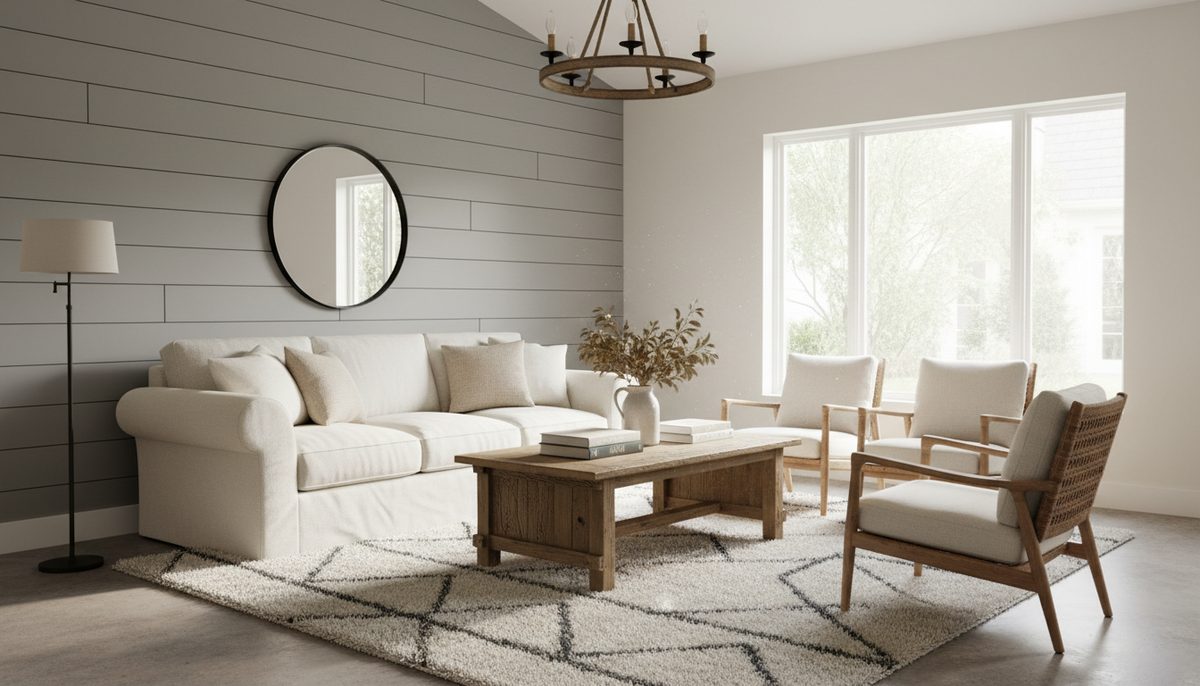
Deciding on wall paneling means picking a style that matches your home and your budget. The most common mistake is to see paneling as just wood planks. You have options from solid wood to MDF and even PVC, each with pros and cons regarding cost, durability, and installation.
Consider the room’s function. For high-moisture areas like bathrooms or kitchens, PVC or moisture-resistant MDF panels are your best bet. Solid wood looks great but can warp if not properly sealed and maintained. For living rooms or bedrooms, the aesthetic possibilities are wider, and cost might be a bigger factor.
Shiplap and beadboard: classic choices
Shiplap paneling features smooth, clean lines where each board slightly overlaps the next, creating a subtle groove. This look evokes coastal or farmhouse styles. You’ll typically find shiplap in 4-inch or 6-inch widths, usually installed horizontally. The material is often pine or cedar, though MDF versions are common and more budget-friendly. For DIYers, pre-primed MDF shiplap is easy to cut and paint.
Beadboard, on the other hand, uses narrow planks with a small bead or rounded edge running vertically between them. It’s traditionally used for wainscoting (paneling the lower portion of walls) but can be used on full walls for a cottage or country feel. Beadboard comes in sheets or individual tongue-and-groove planks. Sheets are faster to install but offer less flexibility in design. Individual planks offer a more authentic look but take longer to put up.
Installation basics for shiplap and beadboard
Whether you choose shiplap or beadboard, the installation process shares similarities. Start by locating wall studs using a stud finder. This is crucial for securely fastening the panels. If you’re using individual planks, begin in a corner, ensuring the first board is level. Most shiplap and beadboard systems use a tongue-and-groove or overlapping joint. You’ll typically nail the panels into the studs using a finish nailer. For shiplap, ensure each board is level before nailing.
When working with full sheets of beadboard, you’ll need to cut around outlets and switches. Measure carefully and use a jigsaw for clean cuts. For both types, plan your cuts to minimize waste, especially if you’re using expensive wood. Leave a small gap (about 1/8 inch) between panels and the ceiling and floor to allow for expansion and contraction. This gap will be covered by baseboards and crown molding.
Painting is usually the final step. For a professional finish, use a high-quality primer, especially on MDF or raw wood. Then, apply two coats of your chosen paint. Satin or semi-gloss finishes are common for durability and ease of cleaning.
Board and batten: depth and dimension
Board and batten is a versatile style that adds architectural interest. It consists of wide vertical boards, usually 4 to 12 inches wide, spaced evenly apart. Thin vertical strips, called battens, are then applied over the seams between the boards and sometimes over the center of the boards themselves. This creates a layered, dimensional effect.
Board and batten is often installed as wainscoting, but full-wall applications are increasingly popular. It can create a modern farmhouse look or a more traditional, stately appearance depending on the board width and spacing. The battens can be 1 to 3 inches wide, and the spacing between the wider boards typically ranges from 8 to 16 inches on center.
Installing board and batten
The installation starts similarly to shiplap and beadboard: find studs. For a wainscoting application, you’ll first install a baseboard or a horizontal “chair rail” board to serve as the top or bottom guide. Then, you’ll attach the wider boards vertically, spacing them evenly and ensuring they are plumb (perfectly vertical). After the wide boards are secured, you’ll add the narrow battens over the seams. This layering adds depth. You can use a level to ensure the battens are straight.
For full-wall installations, you might opt for a simpler version where you only use battens spaced evenly on a flat wall, creating a similar dimensional effect without the wider boards. This is often faster and less material-intensive.
Finishing board and batten involves caulking any gaps between the boards and the wall, especially at the top and bottom. Then, prime and paint. Darker colors can emphasize the dimensionality, while lighter colors offer a more subtle effect.
MDF vs. Solid Wood vs. PVC paneling
When selecting your wall panels, the material is a key consideration.
MDF (Medium-Density Fiberboard)
MDF is engineered wood product made from wood fibers, wax, and resin. It’s dense, smooth, and takes paint exceptionally well. It’s also more affordable than solid wood and is available in various profiles, including shiplap and beadboard. The main drawback is its susceptibility to moisture damage. If MDF gets wet, it can swell and disintegrate. It’s also heavier than wood. However, for dry areas and a painted finish, MDF is an excellent, cost-effective choice.
Solid Wood
Solid wood offers the most authentic and premium look. Pine, cedar, and poplar are common choices for paneling. It can be stained or painted. Solid wood is durable and can add significant value to your home. The downsides are cost – it’s the most expensive option – and it requires more careful installation to account for expansion and contraction with humidity changes. It can also be prone to warping if not installed correctly or in high-moisture environments.
PVC (Polyvinyl Chloride)
PVC paneling is a plastic-based material. It’s completely waterproof, making it ideal for bathrooms, showers, garages, or any area exposed to moisture. It’s lightweight, easy to clean, and often comes in pre-finished colors or patterns. Installation is typically straightforward, often with interlocking systems. The main disadvantage is that it can look less premium than wood and can be scratched or dented. Some PVC panels might also discolor over time with UV exposure, though high-quality options are more resistant.
Peel and stick wall panels
For a quick and easy update, peel and stick wall panels are an attractive option. These panels, often made from PVC, foam, or even thin wood veneer, have an adhesive backing. You simply peel off the backing and stick them to your wall. They are great for renters or for DIYers who want a fast transformation without specialized tools or permanent changes. You can find them in 3D tile designs, faux wood planks, or geometric patterns. They are generally more affordable and significantly faster to install than traditional paneling. However, their durability and long-term adhesion can vary, and they might not hold up as well in high-traffic or high-moisture areas compared to solid materials.
If you’re looking for a temporary or less permanent solution, consider exploring options like easy peel and stick wallpaper, which offers a similar ease of application but on a larger scale.
Other paneling styles to consider
Beyond the popular shiplap and beadboard, several other paneling styles can dramatically alter a room’s feel.
Tongue and groove
This is a general term for planks that interlock using a tongue-and-groove system, allowing for a tight fit. It’s the mechanism used in many shiplap and beadboard installations but can also be used for full-wall wooden planking in various wood species and finishes. This offers a warm, natural look and can be installed horizontally, vertically, or diagonally.
Wainscoting
Wainscoting refers to the lower portion of a wall being paneled, typically up to chair-rail height (about 32-36 inches). Styles of wainscoting include beadboard, raised panel, flat panel, and board and batten. It adds character and protects the wall from scuffs and damage. The top edge is usually finished with a chair rail or cap molding.
Wall planks
This is a broad category encompassing panels sold specifically as planks. They can be made from wood, MDF, or even composite materials. They come in many finishes, from natural wood grains to painted colors and faux finishes. Some systems are designed for easy DIY installation, while others require more professional techniques. For a unique aesthetic, explore the diverse patterns and textures available in wallpapers, such as those from Yellowstone Wallpaper designs or the elegant collections from York Wallcoverings.
Faux wood panels
These panels mimic the look of real wood but are often made from composite materials or plastics. They are typically lighter, less expensive, and easier to maintain than real wood. They are a good option for achieving a rustic or modern wood look without the cost or installation challenges of solid wood. Some even offer textured surfaces to enhance realism.
Tips for a successful paneling project
Proper planning and execution are key to a professional-looking paneling job.
Measure twice, cut once
This adage is especially true with paneling. Mistakes in measurement can lead to wasted material, particularly with expensive wood planks. Carefully measure the length and width of each wall section you plan to cover. Account for windows, doors, and any other obstructions.
Use a level
Ensuring your panels are plumb (perfectly vertical) or level (perfectly horizontal) is critical. A small deviation can be magnified across the wall, making the entire installation look crooked. Use a spirit level or a laser level for accuracy.
Consider the fastener type
For most wood or MDF paneling, finishing nails are the standard. Use a pneumatic nail gun for speed and consistency. For PVC panels, specific adhesives or screws might be recommended by the manufacturer. Ensure your fasteners are long enough to go through the paneling and securely into the wall studs.
Caulking and filling
Once the panels are installed, use painter’s caulk to fill any small gaps between the panels or between the paneling and the trim (baseboard, crown molding). For MDF, use wood filler on any nail holes or imperfections before priming and painting.
Painting techniques
A smooth, durable paint finish makes a huge difference. Use a high-quality primer designed for your specific material (e.g., MDF primer). Apply paint in thin, even coats. A sprayer can provide a very smooth finish, but careful brush and roller work can achieve excellent results too. For beadboard or shiplap with grooves, a small brush or an artist’s brush is useful for painting into the crevices.
For patterned walls, you might want to explore the vibrant collections from Rifle Paper Co. wallpaper or floral designs from our floral wallpaper selection, which offer different ways to add texture and color to your walls.
Maintaining your paneled walls
The maintenance required depends on the material. Painted wood or MDF panels can be cleaned with a damp cloth and mild soap. For tougher stains, use a non-abrasive cleaner. Avoid excessive moisture, especially with MDF. PVC panels are very easy to clean and can typically be wiped down with a damp cloth. Solid wood, if stained, may require occasional reapplication of a protective finish, especially in high-traffic areas.